





Two white colonial houses with lit windows and black shutters photographed at dusk along a tree-lined residential street.

Mini Split Installation in Augusta, ME

Tell us about the job

Takes about a minute. No obligation.

New system or replacementMini-splitKennebec County, ME
Step 1 of 2

What ZIP code is the job in?

Kennebec County saw 107 severe weather events between 2015 and 2024, with damaging wind and winter storms the most common. A mini split's outdoor unit sits exposed to that weather, so where it gets mounted matters. A spot under an eave or away from the roof line keeps falling ice and snow off the top of it. Most Maine households lost power for a full day or longer in 2024, and that's worth planning around too. Mini splits run on electricity with no backup, so an outage takes down your heat the same as any furnace with an electric blower. If backup power matters to you, that's a conversation to have before installation, not after the first outage.

9 months
September through May, your system heats
2 months
July through August, it cools
13°F
the average winter night it heats against
77°F
the average summer afternoon it cools against
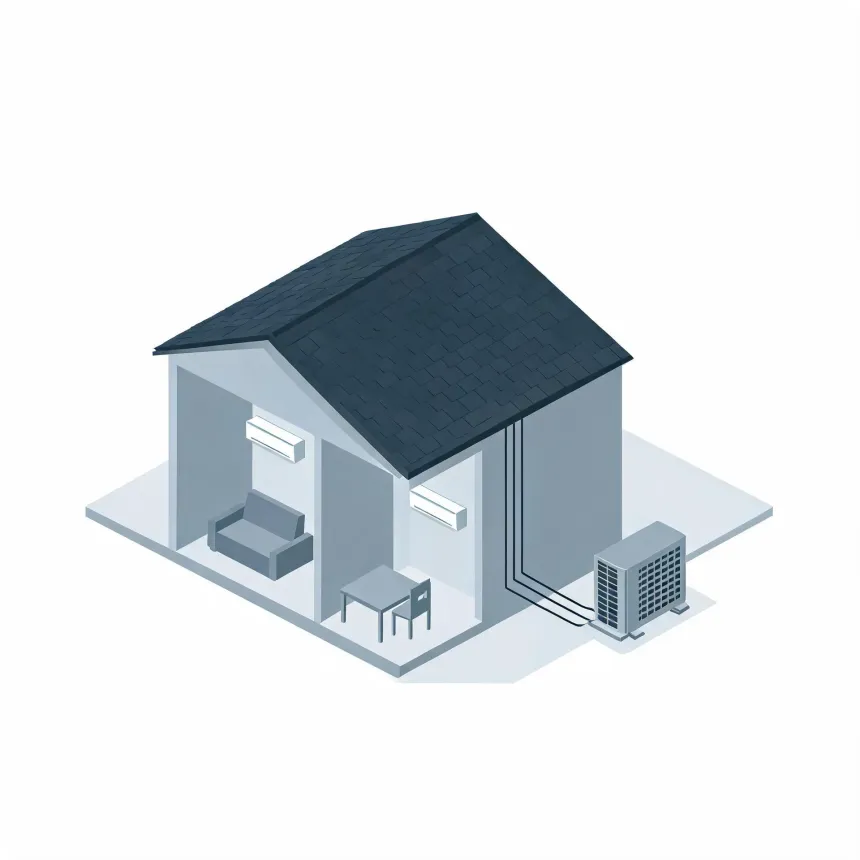
Isometric illustration of a cutaway house with a dark shingled gable roof, showing two wall-mounted indoor air handlers, a sofa, table and chair inside, and refrigerant lines running to an outdoor condenser unit beside the building.
Your system heats September through May and cools July through August.

NOAA nClimDiv, 1991–2020 normals

Half the homes in Kennebec County were built in 1975 or earlier, half in 1975 or later.

Neither age calls for a bigger or pricier system, just one sized to the space it's heating and cooling.

Most Kennebec County homes heat with oil, which is exactly what a mini split can take pressure off

61.7% of homes heat with fuel oil
Cooling runs July through August
Summer afternoons average 77°F

Cooling here only has to carry two months, July and August, with afternoon highs averaging 77°F. That's a light summer workload for a mini split, nowhere near what the same unit would face further south. Winter is the opposite story, long and cold under zone 6A, which is the load that actually sizes the system. For a house this is good news. You don't need top-tier efficiency to get through a mild summer, so look for a unit that's solid and well matched to the space rather than the highest number on the spec sheet. Put the money into correct sizing and a good installation instead.

Zone 6A sets the minimum a mini split has to meet, and a tax credit is available on top of it

Any mini split going in here has to meet 14.3 SEER2 for cooling and 7.5 HSPF2 for heating, the federal minimum for split-system heat pumps. That floor is easy to clear without paying for top-tier efficiency, since the light summer load here doesn't call for it. A federal tax credit is available toward the cost of a qualifying system, on top of whatever it's already built to meet.

Find a contractor
A man in a cap, gray T-shirt and tan work pants climbs porch steps toward a blue front door, carrying a canvas tool bag in his right hand, with a potted shrub in a blue planter beside the door.
A beige split-system air conditioner outdoor condenser unit mounted on metal wall brackets atop a stucco wall.

Get it in before July

Cooling here only runs two months, July and August. June is the month to get the installation done, before the first hot stretch hits. Schedule it then and an installer can do the job on a normal timeline instead of working you in between emergency calls. It also means the system is running and proven before winter puts the real load on it.

How many zones the system covers

A single outdoor unit can run one indoor head or several. Each added zone needs its own line set, its own mounting job, and its own control, so a whole-house setup with several heads costs more than a one-room install. More zones also mean more decisions about where each head goes and how the lines get run between floors or around the outside of the house.
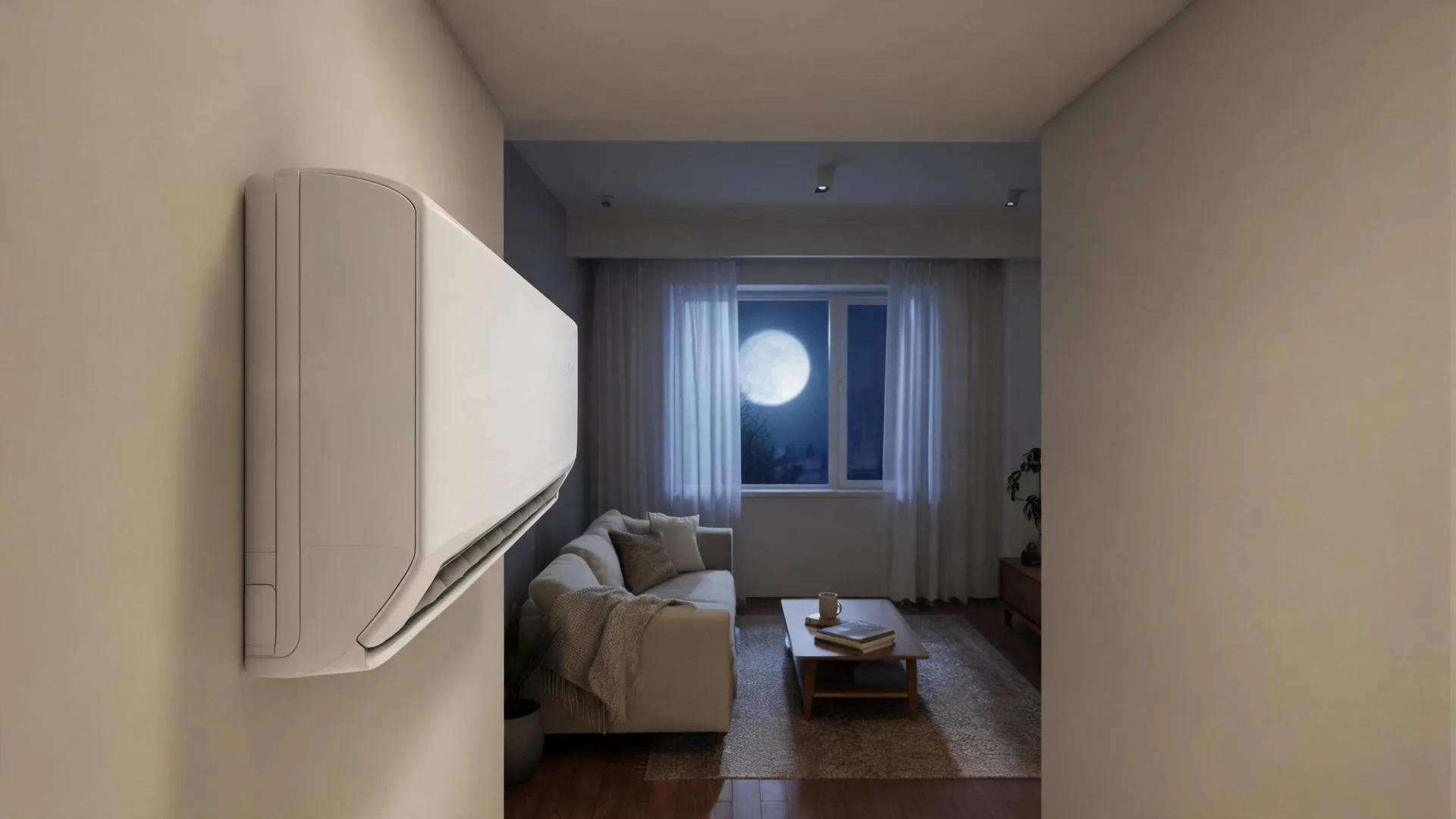
What the installer finds once the wall is open

The quoted price assumes a straight line run and an easy spot for the outdoor unit. If the line set has to travel farther than expected, cross through framing, or the electrical panel needs a new circuit to handle the load, that work gets found after the job starts, not before. A good installer walks the space first and prices for what's actually there instead of guessing.

A mini split sized wrong shows up fast in how the room feels. Too big and it blasts the room down to temperature and shuts off before it's run long enough to pull the damp out of the air, so the room feels cool but clammy. Too small and it runs flat out all day without ever catching up to the thermostat, which puts steady strain on the compressor. Getting it right starts with a room by room heat loss and heat gain calculation, not a guess based on square footage alone. That calculation weighs window area, insulation, ceiling height, and how the rooms connect, because a multi-head system has to split all of that off one outdoor unit. Done right, each zone gets the capacity that room actually needs, no more and no less.

Installation starts outside with the line set, the copper tubing that carries refrigerant between the outdoor unit and each indoor head. That line set has to be run through an exterior wall, so the installer drills a hole sized to fit it along with the drain line and electrical wiring bundled alongside it. Inside, the indoor head mounts on a bracket set into studs, not just drywall, because the unit has to sit flush and stay put. Once the lines are connected at both ends, the system gets evacuated with a vacuum pump to pull out moisture and air before any refrigerant goes in. Skipping that step is the single biggest cause of a mini split failing early, so a careful installer treats it as non-negotiable. The last part is the charge itself, weighed in to match the exact length of line run, then the system gets tested in both heating and cooling before the job is called done.