Two white multi-story colonial houses with lit windows and black shutters photographed at night, fronted by a stone wall.

Mini Split Installation in Bath, ME

Tell us about the job

Takes about a minute. No obligation.

New system or replacementMini-splitSagadahoc County, ME
Step 1 of 2

What ZIP code is the job in?

Oversized cools the air, not the room

A mini split that's too big for the space cools the air fast and shuts off before it pulls the moisture out. The room feels clammy even at the right temperature. The compressor spends its life switching on and off instead of running steady, and that short-cycling wears it down faster than steady use would.

Sizing comes from a load calculation

A contractor works out the right size by running a load calculation on the room. Square footage matters, but so does ceiling height, window area, which way the windows face, how well the room is insulated, and what else in there is giving off heat. That number is what decides which indoor unit and outdoor condenser go in. Matching whatever was there before skips the parts of that calculation that actually change the answer.

9 months
September through May, your system heats
2 months
July through August, it cools
16°F
the average winter night it heats against
76°F
the average summer afternoon it cools against
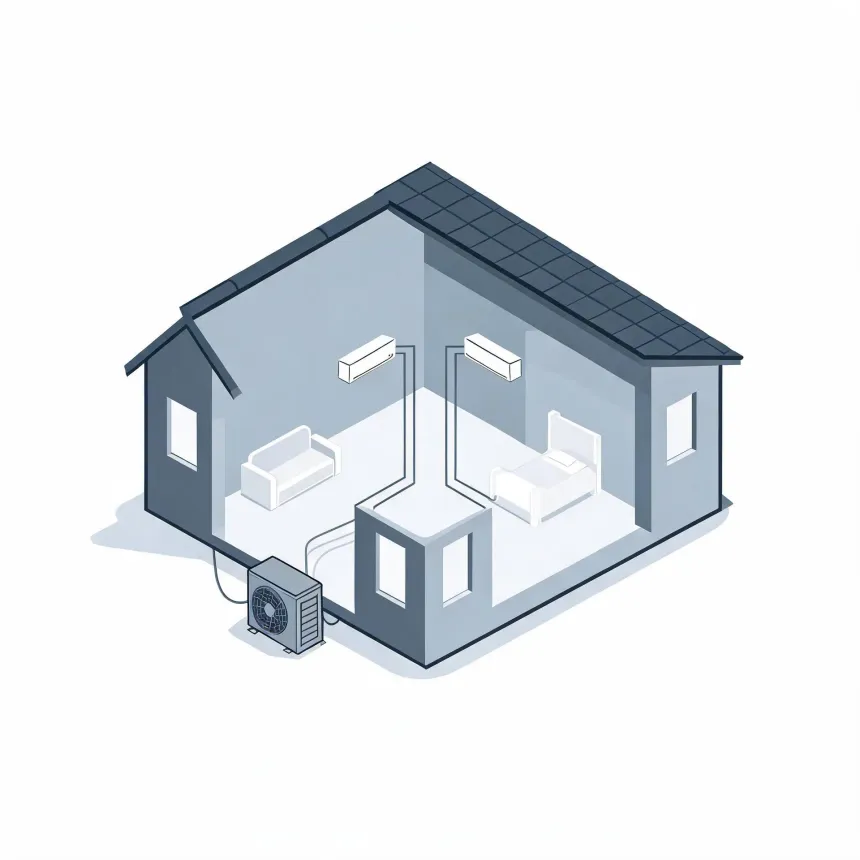
Isometric cutaway illustration of a small house showing two wall-mounted indoor air conditioning units connected by lines to a single outdoor condenser unit beside the building, with a sofa in one room and a bed in another.
Your system heats September through May and cools July through August.

NOAA nClimDiv, 1991–2020 normals

Maine electricity ran 24.29 cents per kilowatt-hour in 2024.

A mini split sized to the actual load keeps that cost down over the compressor's life.

Most homes in Sagadahoc County run on oil, and a mini split works alongside it

53% of homes heat with fuel oil
Cooling runs July through August
Summer afternoons average 76°F
Two months of real workCooling runs July through August here, with afternoon highs averaging 76°F.

Cooling here only runs July and August, so June is the month to get a mini split installed. That gives the contractor room to size the system properly and order the right equipment without rushing either step. Wait until July and a breakdown or an install backlog means riding out a stretch of heat with no cooling at all. Going into those two months with a system already tested and running is worth more than the time saved by waiting.

Any system going in has to meet zone 6A minimums

Sagadahoc County falls under zone 6A, and a mini split installed here has to clear 14.3 SEER2 for cooling and 7.5 HSPF2 for heating, the same federal floor set for every split-system heat pump. That rules out whatever falls short, but it still leaves room to size a unit for this room and this load. A federal tax credit is available on qualifying equipment, worth asking about when comparing what's on the table.

Find a contractor
A man in a cap, gray long-sleeve shirt and tan work pants carries a worn canvas tool bag up wooden porch steps toward a blue front door, with a potted shrub to the left.
A beige split-system air conditioner outdoor condenser unit mounted on metal wall brackets atop a stucco wall.

The old unit doesn't linger

If this is replacing a window unit or an old system tied to the same room, that equipment doesn't need to go anywhere special. A window unit comes out when the new indoor head goes in. A ducted system that's being replaced gets disconnected and hauled off by the contractor as part of the install. Nothing about the old equipment has to wait on the new unit or run alongside it during setup. The one thing worth checking before the old system goes is whether it's tied to anything else, a thermostat zone, a shared return, a line running to another room. A straight swap doesn't run into that problem.

Storms here are frequent, not rare

Sagadahoc County logged 66 severe weather events between 2015 and 2024, most of them winter storms. A mini split's outdoor unit sits outside through all of it, taking wind-driven debris and ice.

Plan for the outage, not just the storm

More than half of Maine households went at least 24 hours without power in 2024. A mini split won't run without electricity, so heat and hot water need a backup plan that doesn't depend on this system alone.

What you pay for in a mini split install is mostly labor, not the box on the wall. Running the line set between the outdoor condenser and the indoor head takes time, and that time goes up with distance and with what's in the way. A straight run through a wood-framed wall is quick. A run that has to go around framing, through brick, or up multiple floors takes longer, and the contractor has to account for that before anyone picks up a tool. The electrical side matters too. Some mini splits run on standard household circuits, others need a dedicated circuit pulled from the panel, and if the panel doesn't have room, that's its own job before the mini split install even starts. Multi-zone systems add another layer, since each indoor head needs its own line set and its own path back to the outdoor unit. None of this shows up in the price of the equipment itself. It shows up in what it takes to get that equipment running the way it's supposed to.

Install day starts with the outdoor unit. The contractor sets the condenser on a pad or wall bracket, somewhere with clear airflow on all sides and room to service it later. Inside, the mounting plate goes up first, then the indoor head hangs on it once the wall sleeve is cut and the line set is fed through. That line set carries refrigerant lines, a condensate drain, and electrical wiring together, wrapped and sealed where it passes through the wall. Once everything is connected, the system gets evacuated with a vacuum pump to pull out air and moisture before refrigerant ever enters the lines. Skip that step and moisture sitting in the lines turns into problems months later. The contractor charges the system, tests it running in both directions, and checks the drain line actually moves water before calling the job done.