




A dark modern bedroom with grey bedding, a wall-mounted air conditioning unit, and a cat resting on the bed.

Mini Split Installation in Calais, ME

Tell us about the job

Takes about a minute. No obligation.

New system or replacementMini-splitWashington County, ME
Step 1 of 2

What ZIP code is the job in?

Most homes in Washington County run on fuel oil or kerosene, 59.2 percent of them, and almost none are on utility gas. A mini split doesn't replace that oil furnace for whole-house heat. It takes over the rooms you actually use day to day, and lets the furnace back off instead of running full tilt to cover the whole house. Some homes are adding one for the first time, others are replacing an old electric baseboard or window unit setup. Either way, the oil system stays in place as backup, which matters when oil is already what the house is built around.

9 months
September through May, your system heats
14°F
the average winter night it heats against
76°F
the average summer afternoon it cools against
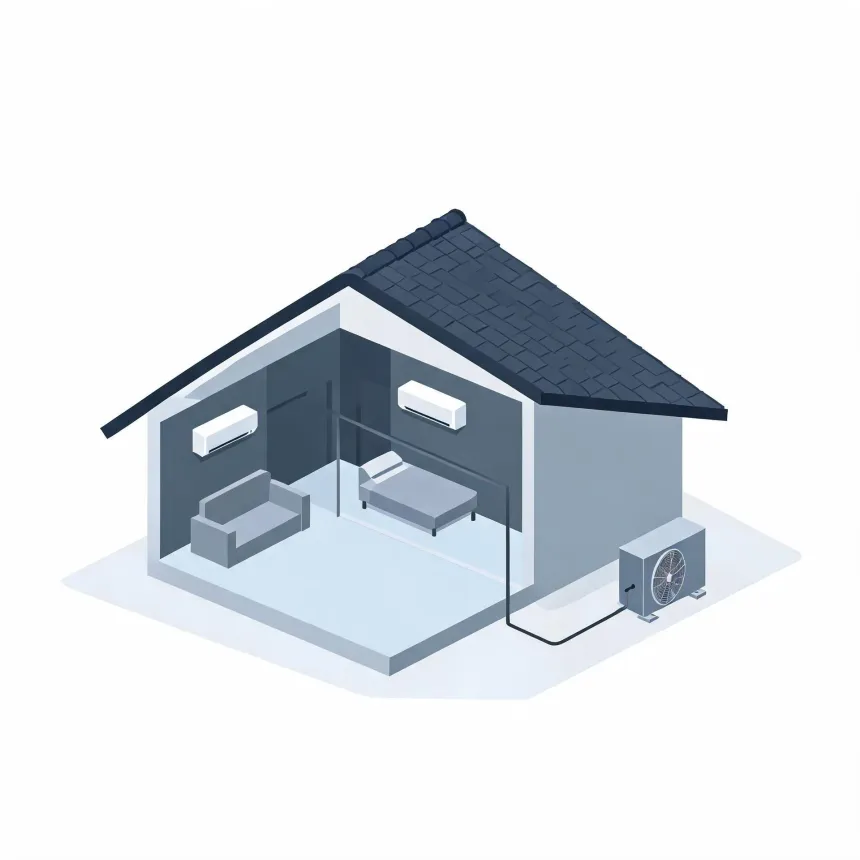
Isometric illustration of a cutaway house showing two wall-mounted indoor air conditioning units connected by a line to an outdoor condenser unit beside the building, with a sofa and bed inside.

Half the homes in Washington County were built in 1975 or earlier, half later.

Old or new, the rooms a mini split heats and cools call for a standard size here.

A standard mini split handles what this climate asks of it

Power costs 24.29 cents a kWh statewide
Summer afternoons average 76°F
67 damaging wind events from 2015 to 2024

Washington County sits in climate zone 6A, a cold climate with winter running long. Any ductless heat pump installed here falls under the same federal rule as other split systems. Units made from 2023 on have to hit at least 14.3 SEER2 for cooling and 7.5 HSPF2 for heating. There's no separate, lower bar for ductless. That rating covers how efficiently the unit moves heat, not how much space it can handle, so it narrows the field to equipment built for real cold rather than mild-climate models. A system meeting that standard may also qualify for the federal energy efficiency tax credit, worth checking before buying.

A mini split here does one job well, not two

Summers here barely ask anything of a cooling system. Afternoons average 76°F through June, July and August, and no month runs warm enough to call for AC at all. The work this unit does will almost all be heat, in a place built for cold. That's a lighter life than most mini splits see. It doesn't need to be the top of the line. It needs to be sized right and able to hold up through the wind and storms this county actually gets.

Find a contractor
A man in a cap, dark jacket and tan work pants climbs porch steps toward a blue front door, carrying a canvas tool bag in his right hand, with a potted shrub beside the entry.
A white mini-split air conditioner outdoor condenser unit mounted on metal brackets against a beige stucco exterior wall, with a blue sky and scattered clouds in the background.

Years of light work, if the install holds up

No month here puts real load on a cooling system, and heating runs long but steady rather than hard. A unit sized right for the rooms it covers can do this for years without strain. Put the money saved on a top-tier model toward one that's installed and mounted to hold up through wind, since this county sees damaging wind far more often than hail or tropical storms.

Ask how many zones one outdoor unit can carry

A single outdoor compressor can often run more than one indoor head, which matters if more than one room needs coverage. Ask whether the rooms here are better served by one multi-zone outdoor unit or separate single-zone systems. More zones on one compressor costs less to install but means every room on it shares capacity, so if one head is working hard the others feel it.
Ask what happens when the power goes out

A mini split stops delivering heat the moment power drops, same as any electric system, and it won't restart on its own with a special sequence, it just comes back when the power does. Ask whether the system has any backup plan built in, or whether that job falls entirely to the oil furnace already in the house. Knowing which system carries the house during an outage is worth settling before anything is installed.

SEER2 and HSPF2 are both ratios, how much heat moved compared to power used to move it. A higher number means the unit gets more heat out of the same amount of electricity, in the room and out of it. That rating says nothing about how big a space the unit can cover. A high efficiency head sized wrong for the room still runs poorly, cycling on and off or struggling to keep up. The rating also assumes the unit is installed and charged the way it was designed to run. A refrigerant line charged off spec or a head mounted somewhere it can't pull air properly will run below the number on the label no matter how good that number was to start.

Installation starts with the lines, not the equipment. The indoor head and the outdoor unit connect through a small hole drilled in the wall, carrying refrigerant lines, a drain line, and electrical wiring bundled together. That hole gets sealed against weather once the lines are run, so water and air don't follow them inside. Before any of that, the lines get pressure tested and then pulled down to a vacuum to clear out moisture and air, since either one left in the line leaves the system running on a bad charge no matter how carefully it's installed otherwise. Only after the vacuum holds does the technician open the valves and let refrigerant into the lines. The last stretch is power and startup, checking that each head calls for heat or cooling correctly and that the outdoor unit responds.