






A row of similar two-story houses with gray siding and dark shingled roofs stands behind a long white vinyl fence, with mown grass in the foreground and large trees behind.

Mini Split Installation in Dover-Foxcroft, ME

Tell us about the job

Takes about a minute. No obligation.

New system or replacementMini-splitPiscataquis County, ME
Step 1 of 2

What ZIP code is the job in?

Ask what each indoor head is rated to heat or cool, not just the total for the whole system. A unit sized for a big open room will struggle in a small closed one, and the other way around. Ask how many indoor heads the outdoor unit can run and whether it's a single zone or multi zone setup, since that changes how the system handles different rooms calling for heat or cooling at the same time. Ask about the line set, the copper tubing that runs between the outdoor unit and each indoor head, since a longer run or more bends can change how the system performs. Ask what happens at low outdoor temperatures, because not every heat pump keeps producing heat once it gets cold enough, and some switch to backup heat or stop keeping up. Ask who handles the electrical work, since each outdoor unit needs its own dedicated circuit.

10 months
September through June, your system heats
6°F
the average winter night it heats against
74°F
the average summer afternoon it cools against
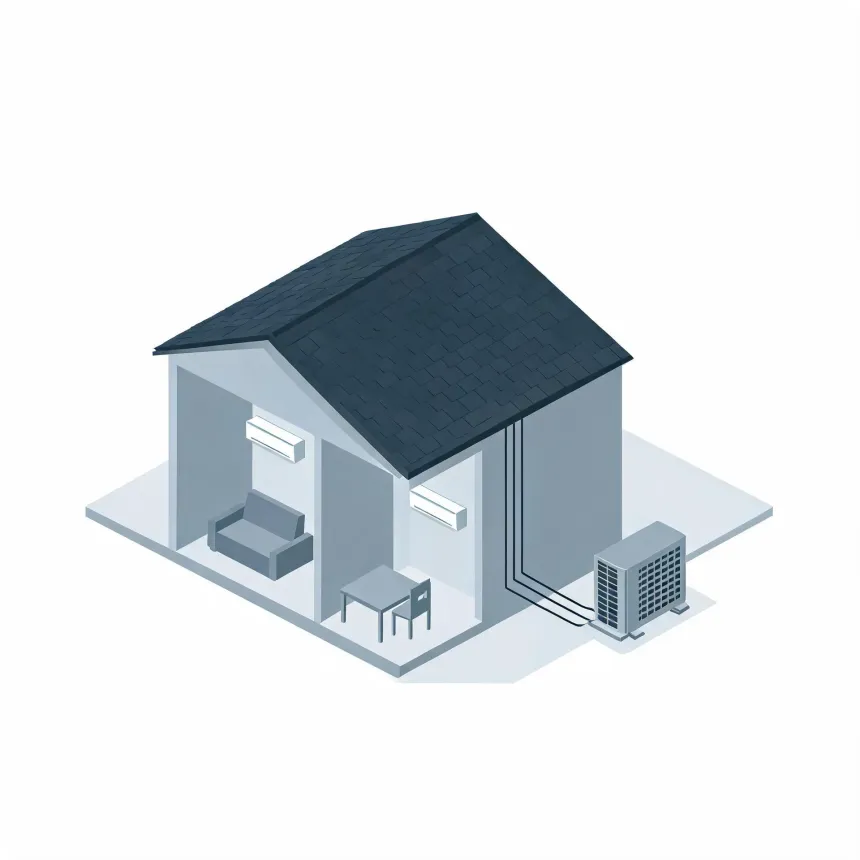
Isometric illustration of a cutaway house with a dark shingled gable roof, showing two wall-mounted indoor air handlers, a sofa, table and chair inside, and refrigerant lines running to an outdoor condenser unit beside the building.

A mini split sized right for Dover-Foxcroft keeps running on standard equipment, nothing oversized or special ordered.

At 24.29 cents per kilowatt-hour, the right size matters more than going bigger for the sake of it.

Summers here don't ask much of a mini split

Summer afternoons average 74°F
61 damaging wind events from 2015 to 2024
16 hail events from 2015 to 2024
What heats Piscataquis County nowFuel oil or kerosene heats 54.4% of occupied homes here, more than any other fuel.

Half the homes in Piscataquis County were built in 1978 or earlier, half in 1978 or later. That split doesn't call for a bigger system or a different one. A mini split sized to the room does the job whether the house is older or newer, because what decides the right size is the room itself, its dimensions and how it's laid out. If your home still has its original windows or walls, mention that to the contractor. It's worth knowing, but it's not a reason to size up.

Zone 6A sets the floor for what can go in

Piscataquis County falls in climate zone 6A, and any mini split installed here has to meet 14.3 SEER2 for cooling and 7.5 HSPF2 for heating, the same federal minimum that applies to every split-system heat pump. That rules out underperforming equipment before you even start comparing brands. A federal tax credit is available for qualifying heat pump installations, worth asking about when you're pricing out the job.

Find a contractor
A man in a cap, gray T-shirt and tan work pants climbs porch steps toward a blue front door, carrying a canvas tool bag in his right hand, with a potted shrub in a blue planter beside the door.
A beige split-system air conditioner outdoor condenser unit mounted on metal wall brackets atop a stucco wall.

Most of its hours are heating hours

The time-lapse here leans almost entirely toward heating. Afternoons in Piscataquis County average 74°F in June, July and August, so the outdoor unit never has to work hard on the cooling side, and most of its hours on the clock will be heating hours instead. That's the load that matters when you're comparing equipment. There's no reason to pay more for cooling capacity this area won't call on. A unit that meets the zone 6A minimum and fits the room handles what summer here actually asks of it.

The old unit has to come out first

If the home is replacing a furnace or boiler, the contractor disconnects the fuel line or ductwork feeding it and removes the unit. If it's an old window AC or electric baseboard being replaced, those come out too. None of this gets reused. A mini split works on its own line set and its own wiring, so the old heating or cooling path just goes away once it's disconnected.
The chimney or oil tank might stay or go

A fuel oil furnace or boiler usually comes with a chimney liner and sometimes an outdoor tank. Taking the mini split route doesn't automatically mean either has to come out. Some homes keep the old system as backup for the coldest stretches and just stop using it day to day. That's a decision to make with the contractor, not something the mini split install forces one way or the other.

The equipment itself is only part of the bid. What the outdoor unit needs to reach the right spot on the wall matters just as much, and so does what's already there to connect to. A straight line set run costs less than one that has to go around corners or up through a chimney chase. Electrical work adds to the job if the panel doesn't have room for a new dedicated circuit, or if the run from the panel to the outdoor unit is long. Where the indoor head goes and how the wall is built behind it changes how much cutting and patching the job takes. Multi zone systems cost more to install than single zone ones simply because there's more line set, more wiring, and more indoor heads to mount and test.

Installation day starts with the outdoor unit and the indoor head going up before anything gets connected. The installer mounts the indoor head on its bracket, drills a small hole through the wall behind it, and runs the line set, the wiring, and the drain line through that opening to the outdoor unit. Once everything is in place, the line set gets connected at both ends and the whole system is evacuated with a vacuum pump to pull out air and moisture before refrigerant is released into it. Skipping that step is what causes a system to run poorly or fail early, so it's not something a contractor shortcuts. After that, the electrical connections get made, the system is powered on, and the installer checks refrigerant pressure, airflow at the indoor head, and that the thermostat or remote is actually controlling the unit. Expect some drilling, some noise, and a final walkthrough on how to run it.