White colonial-style houses with lit windows photographed at dusk along a tree-lined street.

Mini Split Installation in Ellsworth, ME

Tell us about the job

Takes about a minute. No obligation.

New system or replacementMini-splitHancock County, ME
Step 1 of 2

What ZIP code is the job in?

Weather here is hard on outdoor units

Hancock County logged 155 severe weather events between 2015 and 2024, most of them damaging wind or winter storms. A mini split's outdoor unit sits outside year-round, so where it's mounted and how it's shielded from wind and falling ice matters more here than in a calmer county.

Outages last longer than people expect

More than half of Maine households went at least 24 hours without power in 2024. A mini split needs electricity to run, heat or cool, so it's worth asking an installer about backup power if keeping the system alive during an outage matters to you.

9 months
September through May, your system heats
1 months
July through July, it cools
14°F
the average winter night it heats against
76°F
the average summer afternoon it cools against
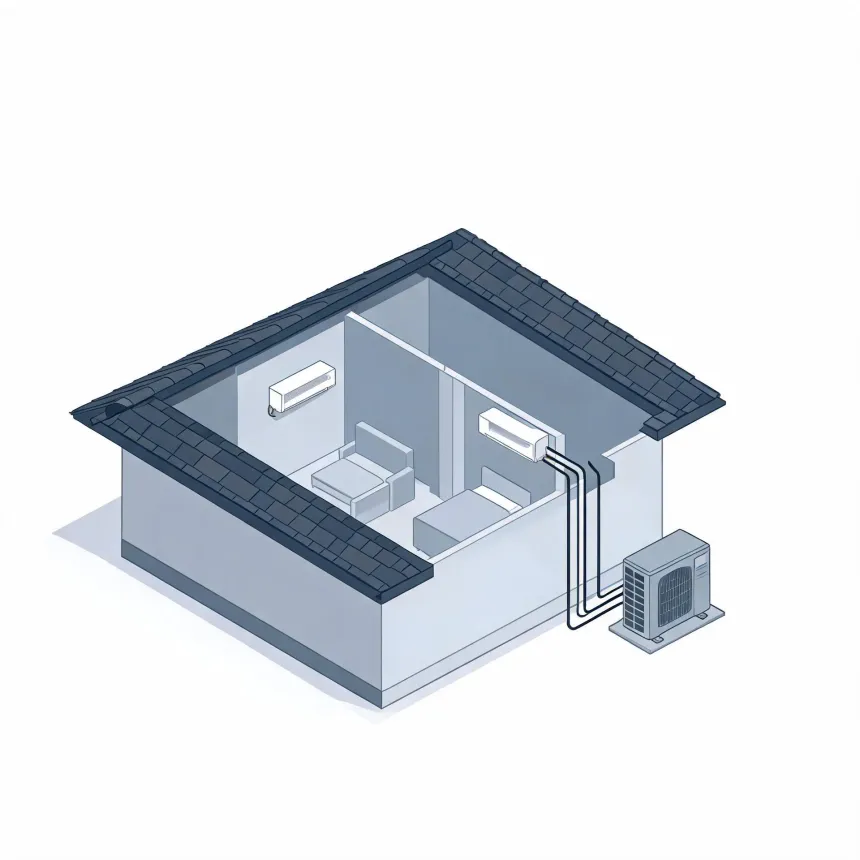
Isometric illustration of a cutaway house with tiled roof showing two wall-mounted indoor mini-split units connected by line sets to an outdoor condenser beside the building.
Your system heats September through May and cools July through July.

NOAA nClimDiv, 1991–2020 normals

A mini split sized right for Ellsworth runs on standard equipment, nothing special.

Electricity here runs 24.29 cents a kilowatt-hour, so the install is the thing worth getting right, not an oversized unit.

One month of cooling is all this system gets, so have it ready by June

Cooling runs July through July
Summer afternoons average 76°F
75 damaging wind events from 2015 to 2024
Most homes here run on oil, not electricityFuel oil or kerosene heats half of Hancock County's homes, more than any other fuel

Hancock County sits in zone 6A, a cold climate with winter running long here. A mini split counts as a split system under the federal standard, there's no separate category for ductless. So any unit manufactured from 2023 on has to hit at least 14.3 SEER2 for cooling and 7.5 HSPF2 for heating. That's the floor. A unit that barely clears it on paper is the one most likely to struggle once cold weather settles in for months, not weeks. Worth asking the installer what rating they're actually quoting, and whether it's sitting right at the minimum or above it.

One month of real work a year, so reliable beats fancy

July is the only month cooling runs here, with afternoon highs averaging 76 across the whole summer. That is not a heavy workload for an outdoor unit. A straightforward system sized right for this house will handle it without strain, and you are not paying for cooling capacity this house will rarely ask for. Put the money into the installation instead.

Find a contractor
A white mini-split air conditioner outdoor condenser unit mounted on metal brackets against a beige stucco exterior wall, with a blue sky and scattered clouds in the background.

Light duty, so pick for reliability, not for the spec sheet

One month of cooling work a year is a light ask for an outdoor unit. Don't let that push you toward the cheapest box on the lot. The case for a reliable unit over a loaded one still holds when you're picking between bids. Ask what's actually being installed, not just the brand on the case.

Sizing comes from a room by room load calculation

A mini split gets sized by working out how much heat each room loses in winter and gains in summer, based on window area, wall area, ceiling height and what's on the other side of each wall. A contractor measures the rooms and runs that calculation rather than going by square footage alone or matching whatever unit was there before.

Oversized hurts more than undersized

A unit too big for the room cools or heats it fast, then shuts off, then kicks on again a few minutes later. That cycling never lets the system settle into steady operation, so it struggles to hold even humidity or even temperature, and the compressor wears from starting and stopping instead of running steady. A unit sized correctly runs longer stretches at low output, which is both how it's most efficient and how it's easiest on the equipment.

Ask how many indoor heads are going on one outdoor unit. A single zone system ties one indoor head to one outdoor compressor, so it runs exactly as sized for that one room. A multi zone system ties several indoor heads to one outdoor compressor, and that compressor has to modulate across whatever mix of rooms are calling for heat or cooling at once. That's a harder job than sizing for one room, and it narrows the field to equipment built to do it well. Ask what happens if one indoor head fails. On some multi zone systems the rest keep running, on others the whole system goes down, and that's worth knowing before you buy. Ask too about the line set, the refrigerant piping between outdoor and indoor units. A longer run between them can affect how the system performs, and it's a fair question for whoever is bidding the job.

Installation starts outside, with the outdoor unit. The crew sets the mounting pad or wall bracket, then runs the line set, a refrigerant line, a condensate drain and an electrical whip, through a hole drilled in the wall. That hole is the only penetration the job needs, which is part of what makes a mini split faster to put in than ductwork. Inside, the indoor head goes up on a bracket, the lines connect, and the system gets evacuated with a vacuum pump to pull out air and moisture before refrigerant goes in. A tech checks the charge against what the line length calls for, since too little or too much refrigerant both hurt performance. Once it's running, expect the installer to test heating and cooling on each head before calling the job done.