





A two-story red brick house with a dark roof and white-trimmed windows sits on a lawn behind a stone retaining wall, framed by large leafy trees under an overcast sky.

Mini Split Installation in Farmington, ME

Tell us about the job

Takes about a minute. No obligation.

New system or replacementMini-splitFranklin County, ME
Step 1 of 2

What ZIP code is the job in?

Ask what the unit is rated to do at low outdoor temperatures, not just what it does on a mild day. Every mini split has a capacity curve, and that curve drops as it gets colder outside. A unit that heats well enough most days might struggle on the coldest ones, and some cut out entirely below a certain point. Ask about the size of each indoor head against the room it serves, since an oversized head will short cycle and an undersized one will run constantly and still fall behind. Ask how many indoor heads one outdoor unit can carry, because splitting capacity across too many zones weakens all of them. And ask who services the brand locally, since a mini split with no one nearby to source parts for it is a harder machine to live with down the road.

10 months
September through June, your system heats
8°F
the average winter night it heats against
73°F
the average summer afternoon it cools against
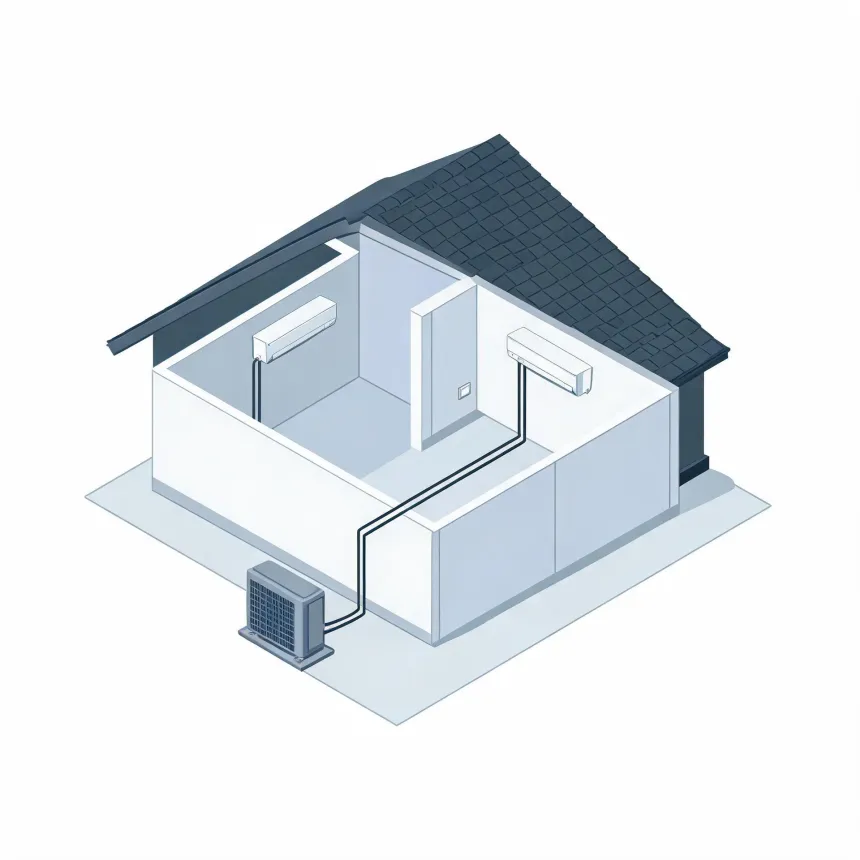
Isometric cutaway illustration of a small house with a dark shingled roof, showing two wall-mounted indoor air conditioning units in separate rooms connected by lines to an outdoor condenser unit on the ground outside.

Half the homes in Franklin County were built in 1978 or earlier, half after.

A mini split sized to the rooms it serves works in either one, old or new.

A mild 73° summer means the outdoor unit never has to work hard

Summer afternoons average 73°F
34 damaging wind events from 2015 to 2024
9 hail events from 2015 to 2024
Most homes here run on oil52% of homes in Franklin County heat with fuel oil or kerosene, more than any other fuel.

Franklin County is in climate zone 6A, a cold zone with winters that run long. Any mini split installed here has to meet the federal minimum for split-system heat pumps, and that includes ductless units. The minimums are 14.3 SEER2 for cooling and 7.5 HSPF2 for heating. That rule applies to what's manufactured, not what's already in a home, so it narrows what a contractor can sell you new. A federal tax credit is available toward a qualifying system, worth asking about alongside whatever a contractor quotes.

Size it to the room, not the worry

At 24.29 cents per kilowatthour, what a mini split costs to run comes down to sizing. A unit matched to the space it heats and cools does the job without wasting power. There's nothing about Farmington that calls for a bigger or more expensive system than the rooms actually need.

Find a contractor
A beige split-system air conditioner outdoor condenser unit mounted on metal wall brackets atop a stucco wall.

One job, not two

A mini split picked for this county only has to be good at one job. There's no stretch of summer hot enough to call for real cooling, so the compressor doesn't need to be sized for two different demands. It runs on heat from fall through spring and barely gets touched the rest of the year. A mid-range unit matched to the room handles that fine. There's no reason to pay for a bigger or more complex system than the space actually calls for.

What comes out of the wall

A mini split installation leaves the old equipment behind. If a furnace or boiler is being replaced, that unit gets disconnected and hauled off, along with the ductwork if nothing else in the home still uses it. If window units or baseboard heaters are coming out, those go too. None of it gets reused.
The refrigerant has to be recovered

If the old system is a central air conditioner or an older heat pump, it has refrigerant in its lines. That refrigerant can't be vented into the air. It has to be recovered into a tank before the lines are cut, and that's part of the removal job, not an extra step tacked on.

The efficiency rating on a mini split's label, SEER2 for cooling and HSPF2 for heating, tells you how much heating or cooling it gets out of the electricity it uses. It is not a measure of capacity. A unit with a high rating is not necessarily a bigger or stronger machine, just a more efficient one at the size it is. That rating is measured over a full season of running, through mild stretches and hard ones, not at a single moment. So it is worth comparing between quotes, but only once the units being compared are already sized right for the room. A high rating on a head that's too big or too small for the space it serves will not fix the sizing being wrong, and the unit will still run poorly no matter what the label says.

Installation starts outside, not in. The outdoor unit needs a spot on a pad or bracket with clear airflow on all sides and a short, direct run to each indoor head, since every bend and foot of refrigerant line is a place for a leak to start. Each indoor head gets mounted high on a wall or ceiling, over a small hole drilled through to the outside for the line set, the condensate drain and the electrical whip. Once the lines are run, the system gets evacuated with a vacuum pump to pull out all the air and moisture before any refrigerant moves into it. Skip that step and moisture sits in the lines, and that shows up later as a coil that won't get cold or a compressor that wears out early. After charging, a tech checks line pressures against outdoor temperature and confirms each head is actually moving the air it's rated to move, not just running.