A row of illuminated white colonial houses photographed at twilight along a tree-lined road with a stone wall in the foreground.

Mini Split Installation in Lewiston, ME

Tell us about the job

Takes about a minute. No obligation.

New system or replacementMini-splitAndroscoggin County, ME
Step 1 of 2

What ZIP code is the job in?

Weather here is hard on outdoor units

Androscoggin County logged 110 severe weather events between 2015 and 2024, damaging wind and hail among them. A mini split's outdoor unit sits exposed to all of it, so where it gets mounted and what shields it matters as much as the model you pick.

Power cuts last longer than people expect

More than half of Maine households went at least 24 hours without power in 2024. A mini split won't run without electricity, so if backup power matters to you for heat in the winter or cooling in the summer, that's worth planning into the installation now.

9 months
September through May, your system heats
2 months
July through August, it cools
13°F
the average winter night it heats against
77°F
the average summer afternoon it cools against
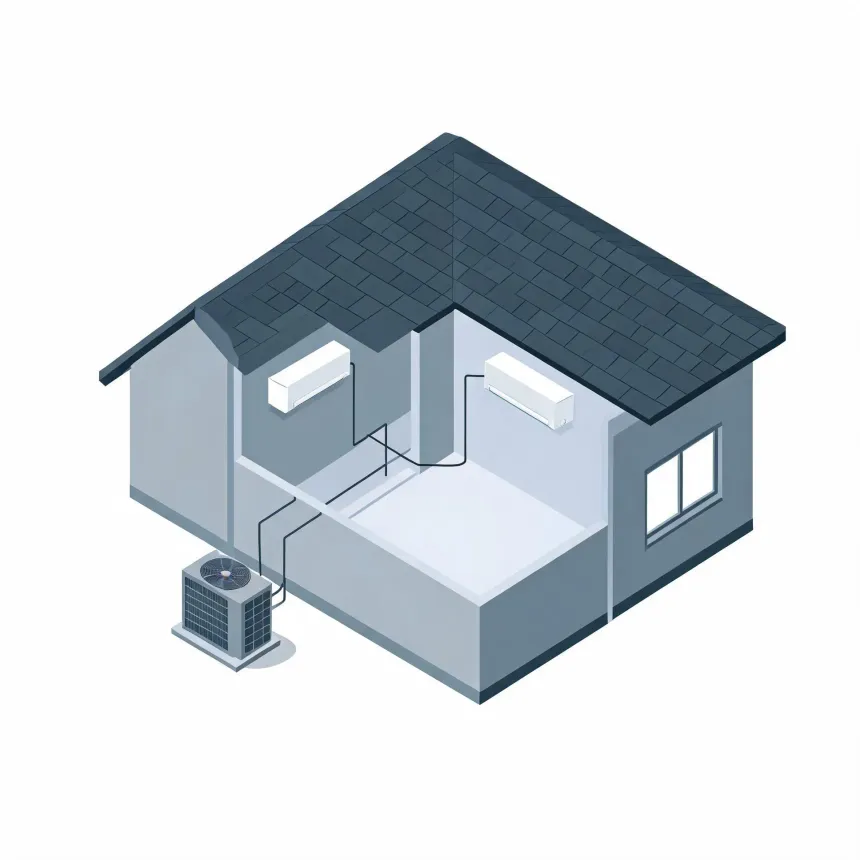
Isometric illustration of a cutaway gray house with a dark shingled roof, showing two wall-mounted indoor air conditioning units connected by lines to an outdoor condenser unit on the ground outside.
Your system heats September through May and cools July through August.

NOAA nClimDiv, 1991–2020 normals

A mini split sized normally handles a Lewiston home fine.

Skip the oversized unit. At 24.29 cents per kilowatt-hour, the standard size is the one that costs less to run.

Half the homes here were built by 1969, and the walls a mini split hangs on are older too

Half the homes here were built by 1969
Cooling runs July through August
Summer afternoons average 77°F
Two months of summer, plenty of winterCooling runs about two months a year here, July and August, with afternoons averaging 77°F.

Cooling here only runs from July through August, so June is the month to get a mini split installed. Wait until July and you're competing with every other homeowner who had the same thought once it got hot. A unit put in during June sits ready before it's needed, tested and running right before the first real load hits it. That takes the pressure off the install itself too, since nobody's rushing to get your air going on the hottest week of the year.

Most homes here heat with oil, so a mini split is the backup, not the replacement

Fuel oil heats close to 6 in 10 homes in Androscoggin County, and gas and electric heat only make up about a fifth between them. A mini split fits into that picture as a second system, handling the two months of summer cooling and taking some load off the oil furnace on the milder days of fall and spring. The oil system stays as what carries the house through the coldest months.

Find a contractor
A white mini-split air conditioner outdoor condenser unit mounted on metal brackets against a beige stucco exterior wall, with a blue sky and scattered clouds in the background.

Light use still means year-round care

A mini split that only carries light loads still needs the same attention as one running full time. The outdoor unit sits outside year round whether it's working hard or barely cycling, so cold, damp and dust reach it on the slow months too. Moisture around the coil can freeze solid if the unit shuts down with condensation still on it, which is why a lot of models run a brief defrost cycle during the cold stretches even when nobody's asked them to cool anything. The filters in the indoor head still pull dust and need rinsing on a schedule, regardless of how many hours the compressor actually ran. A unit that sits idle for long stretches between light duty periods benefits from being powered on now and then rather than left off completely, since a compressor that never runs can develop problems a compressor in regular use would wear past.

The room decides the size, not a formula off the square footage

A load calculation looks at the windows, the insulation, the ceiling height and which way the room faces before it lands on a number. Rooms the same size can still need different sized units once you account for that. Skipping this step and guessing off square footage alone is how a house ends up with a unit that's wrong for the space.

Too big is its own problem, not a safety margin

An oversized mini split cools the room fast, shuts off, then kicks back on soon after. That short cycling means it never runs long enough to pull moisture out of the air, so the room feels cool but clammy. The right size runs longer, steadier stretches and handles humidity as part of doing its job.

The efficiency rating on a mini split, the SEER2 number, tells you how much cooling or heat you get for the power it draws, nothing about how big a space it can handle. A higher rated unit costs more up front and less to run, but only if it's sized right for the room in the first place. Put a high efficiency unit in a room it's wrong for and the rating stops mattering, since it'll short cycle or run flat out no matter what the label says. The rating also gets tested under set conditions in a lab, so it's a way to compare one model against another, not a promise of what you'll see on your own power bill. Worth checking alongside it is the rating for heating output, since a mini split pulling double duty here needs to perform in both directions, not just the one the cooling number describes.

Installation starts with where the lines run, not where the indoor unit looks nice. The refrigerant lines, the condensate drain and the power wire all have to get from the indoor head to the outdoor unit, usually through one hole drilled in the wall. That hole gets sealed tight once the lines are through it, since any gap there is a draft and a way for pests to get in. The outdoor unit gets mounted on a pad or bracket, leveled, and set with clearance on all sides for airflow. Once both ends are in place, the line set gets connected, the system gets pressure tested for leaks, then the air gets pulled out of the lines before refrigerant ever flows. Only after that does the crew power it up and check that it's cooling and heating the way it should.