A long white picket fence runs along a mown grass lawn in front of a row of single-story houses with gray siding and shingled roofs, surrounded by large leafy trees.

Mini Split Installation in Portland, ME

Tell us about the job

Takes about a minute. No obligation.

New system or replacementMini-splitCumberland County, ME
Step 1 of 2

What ZIP code is the job in?

Cumberland County sees real storms

Cumberland County logged 286 severe weather events between 2015 and 2024, from damaging wind to hail to winter storms. An outdoor condenser sitting against the wall or up on a pad takes that weather directly, so where it goes and what shields it matters.

Plan for the outage, not just the storm

Over half of Maine households went at least 24 hours without power in 2024. A mini split won't run without electricity, so if backup power matters for heat or cooling, that's worth raising during installation, not after the lines go down.

9 months
September through May, your system heats
2 months
July through August, it cools
15°F
the average winter night it heats against
78°F
the average summer afternoon it cools against
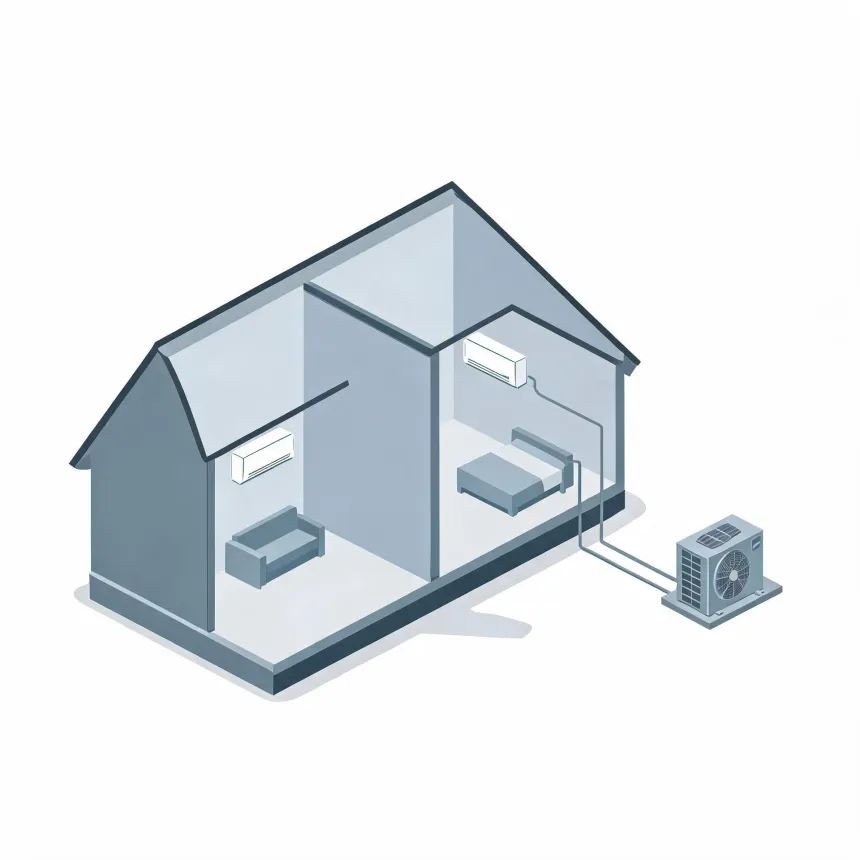
Isometric grey illustration of a cutaway house showing two rooms with wall-mounted indoor air conditioning units connected by lines to an outdoor condenser unit beside the building.
Your system heats September through May and cools July through August.

NOAA nClimDiv, 1991–2020 normals

Cooling in Cumberland County starts in July.

June is the month to get a mini split installed, before the first hot stretch hits.

Two months of real heat a year is not a hard job for a mini split

Cooling runs July through August
Summer afternoons average 78°F
145 damaging wind events from 2015 to 2024
A standard mini split handles Portland fineMaine homes paid 24.29 cents per kilowatt-hour in 2024, and a correctly sized system is what keeps that bill in check.

Winter storms are the weather to plan around here, with 115 logged in Cumberland County between 2015 and 2024, more than any other kind. That's worth raising at the install, not after the fact. Where the line set and outdoor unit sit matters when ice and heavy snow are the regular case, not the exception. A mounting spot clear of roof runoff and drifting snow holds up better than one tucked against a wall where ice can build. Ask about a stand or wall bracket that keeps the unit off the ground, above the snow line.

Any system going in has to meet Maine's cold-climate standard

Cumberland County falls in climate zone 6A, built for long, cold winters. A ductless mini-split counts as a split-system heat pump under federal rules, so any unit made from 2023 on has to hit 14.3 SEER2 for cooling and 7.5 HSPF2 for heating. That's the floor, and it narrows what a contractor can install. A federal tax credit is available on top of that for units that qualify, which is worth bringing up while you're deciding what to put in.

Find a contractor
A man in a cap, navy T-shirt and brown pants carries a waxed canvas tool bag up the steps toward a blue front door of a shingled house, beside a potted shrub.
A white outdoor air conditioner condenser unit mounted on metal wall brackets against gray horizontal siding, with a blue sky and white clouds behind it.

The old system usually doesn't leave right away

The old system doesn't get hauled out the moment the new one goes in. Whatever's there now, a furnace, a boiler, window units, baseboard heaters, usually keeps working alongside the mini split unless someone tells the installer otherwise. A lot of homeowners leave the old heat source in place as backup for the coldest stretches, especially the first winter, while they learn how the mini split handles things on its own. If it's getting removed, that's a separate job from the install itself, and worth asking about up front so it doesn't turn into a surprise later. An old central air condenser or furnace that's getting fully replaced has to be disconnected and hauled off, and refrigerant in an old AC system has to be recovered properly, not vented, so that part of the job falls to whoever's licensed to handle it.

One head or several

A single outdoor unit can run more than one indoor head, each with its own thermostat, or it can run just one room. More heads off one outdoor unit costs less than separate systems but means less flexibility if one zone needs service, since some multi-zone systems pull every indoor head down with it. Ask whether the quote is one outdoor unit split multiple ways or a dedicated system per room, and what happens to the other rooms if one part needs a repair.

Ask who sized the job, not just what size they picked

A mini split that's too big cools or heats the room fast, then shuts off before it pulls the moisture out of the air, which leaves the space feeling damp and uneven. One that's too small runs constantly and never quite catches up on the coldest or hottest days. The right size comes from a load calculation on the actual room, not a guess based on square footage alone. Ask whether that calculation was done and what it accounted for, the windows, the insulation, the ceiling height.

Square footage alone doesn't tell you what a room needs. A load calculation looks at how many windows the room has and which way they face, how well the place holds onto heat, how tall the ceiling runs, what's on the other side of the walls. Rooms the same size can still need different size heads once you account for that. Oversizing is the mistake people lean toward, on the thinking that bigger covers you. It doesn't. A head that's too big blasts the room to temperature and shuts off before it's pulled the humidity down, so the air feels cool but damp, or warm but stale. A head that's too small just runs and runs and never quite gets there on the hardest days. Sizing has to be worked out room by room, not picked off a chart by floor area.

Install day starts with mounting, the outdoor unit set on a pad or bracket, the indoor heads hung on the wall or ceiling. The line set runs between them, copper tubing that carries refrigerant, usually through a hole drilled in the wall, so the crew has to settle on that path before anything gets fastened down. Once everything's connected, the line gets pulled down to a vacuum to clear out air and moisture, because either one left behind will ruin the compressor over time. Only after it holds that vacuum does the refrigerant get released into the lines. Then comes testing, running the system on heat and on cool, checking what each head is putting out, making sure the condensate drain actually drains instead of backing up. A system that's wired right but never run through both modes can hide a problem that only shows up once the weather turns.