





A low-angle view across a mowed lawn toward a single-story light-colored house with a dark shingled roof and dark shutters, framed by large deciduous trees and a blurred shrub in the foreground under an overcast sky.

Mini Split Installation in Rumford, ME

Tell us about the job

Takes about a minute. No obligation.

New system or replacementMini-splitOxford County, ME
Step 1 of 2

What ZIP code is the job in?

Ask how many zones the quote covers and whether one outdoor unit feeds all of them or each head has its own. A single outdoor unit split across several indoor heads saves on equipment but means those heads share total capacity, so ask what happens on the coldest day when every zone calls for heat at once. Ask about the line set length and how many turns it takes to reach the outdoor unit, since a longer run with more bends costs the system some efficiency. Have each bidder say what size unit they're proposing and why, not just a price. Contractors sizing the same rooms should land on similar numbers, and if one is proposing something much larger, ask what that's based on. Also ask where the outdoor unit will sit and how that spot was chosen, since airflow around it matters as much as the wall it hangs on.

9 months
September through May, your system heats
10°F
the average winter night it heats against
75°F
the average summer afternoon it cools against
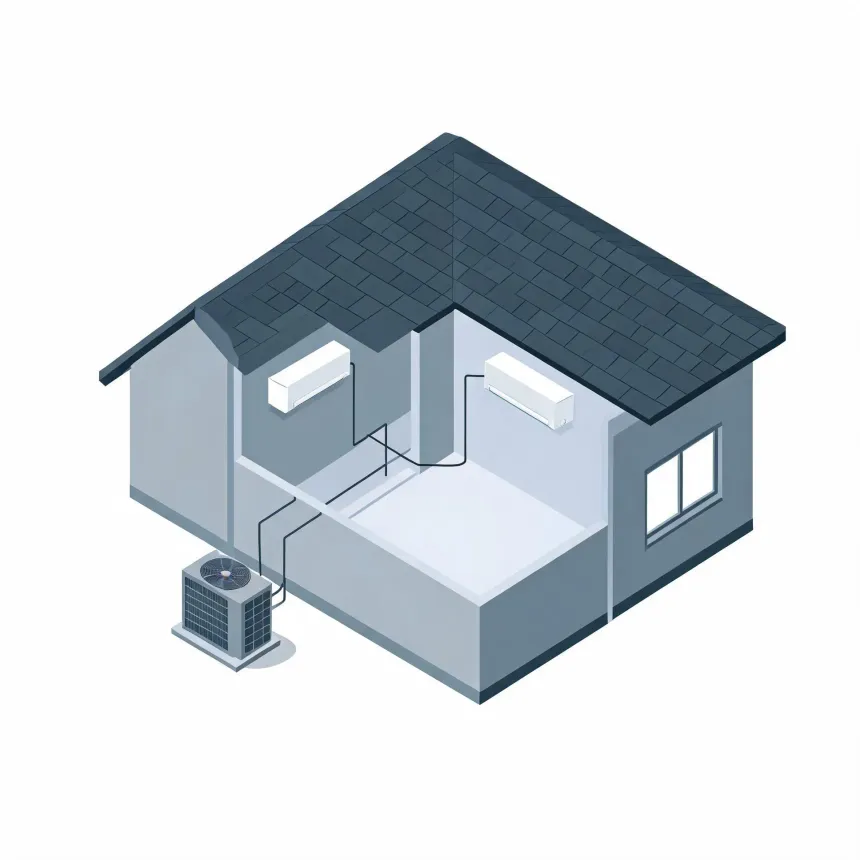
Isometric illustration of a cutaway gray house with a dark shingled roof, showing two wall-mounted indoor air conditioning units connected by lines to an outdoor condenser unit on the ground outside.

Oil heats 58 percent of homes in Oxford County, more than any other fuel.

A mini split works alongside that oil furnace or boiler, taking over the mild months so the oil system runs less.

Summers here barely ask a mini split to work

Summer afternoons average 75°F
77 damaging wind events from 2015 to 2024
20 hail events from 2015 to 2024

Half the homes in Oxford County were built in 1977 or earlier, half later, and that split does not change what size mini split a given room needs. Sizing comes from the room itself, its square footage, how many exterior walls it has, and how many windows let heat in or out. A contractor measures that room and matches the unit to it, whether the house came before that line or after. There's no case for buying bigger here on the theory that older homes need more. An oversized unit cools the room fast and shuts off before it pulls the humidity down, which leaves the room feeling damp instead of comfortable. Ask the contractor to show you the room measurements behind their number, not just the number.

A standard mini split fits this job

Nothing about Rumford calls for oversizing or upgrading past a standard unit. A system sized to the room, installed with a clean line set run, will do the job. At 24.29 cents per kilowatthour, Maine electricity costs make it worth getting that sizing right rather than paying to run a bigger unit than the room needs.

Find a contractor
A man in a cap, dark long-sleeved shirt and brown work pants, seen from behind, carries a worn leather tool bag up porch steps toward a blue front door beside a blue planter with a shrub.
A white outdoor air conditioner condenser unit mounted on metal wall brackets against gray horizontal siding, with a blue sky and white clouds behind it.

Light work, year after year

Afternoon highs average 75°F in June, July and August, and no month here calls for cooling at all. A mini split in this spot is mostly carrying the heating load, not the cooling load, since that's where the real demand sits. Light work year after year means less wear on the compressor and coil, so a repair is usually worth making instead of a sign the unit is done. Put the money into correct sizing and a clean line set instead of a bigger or higher-efficiency unit than this job calls for.

The rating measures heat moved against power drawn

The efficiency number on a mini split's label comes from a season of running, not a single moment. It tells you how much heat the unit moves for the electricity it uses. It says nothing about whether the unit fits the room. A high rating on a unit that is too big for the space still runs up the power bill, because the unit short cycles instead of settling into a steady run.

A high number does not fix a bad size

Contractors quoting different units at different ratings are not quoting the same job until the sizing is settled. Ask for the rating on the exact unit proposed, after the room has been measured, not before. A unit matched to the room on a standard rating will often run cheaper than an unmatched unit with a better rating on the label.

Sizing a mini split starts with heat loss and heat gain for that specific room, not a rule of thumb. A contractor works out how fast the room loses heat in winter and gains it in summer, based on floor area, ceiling height, window area, and how many walls face outside. That number points to a unit size, and the indoor head gets matched to it. Go too small and the unit runs flat out without ever catching up on the coldest or hottest days. Go too big and it cycles on and off fast, cooling or heating the air quickly but never running long enough to pull moisture out or settle into steady, even output. Either mistake shows up as comfort problems that no amount of adjusting the thermostat will fix, because the hardware itself is wrong for the room.

Installation day starts outside, not at the wall. The crew runs the line set between the outdoor unit and the indoor head, and every bend in that path takes something off the system's capacity, so a straight run is worth asking for. Inside, the head mounts on a plate, usually high on the wall, and it gets leveled before anything connects. A head that tilts the wrong way won't drain condensation the way it should. The line set passes through a hole drilled in the wall and connects at both ends, then the whole system gets pressure tested before anyone turns it on. That test catches a bad joint before it becomes a slow leak. Once it holds, the lines get evacuated of air and moisture, then charged. A contractor who skips the vacuum step is leaving moisture in the lines that will cause trouble long after installation day is done.