A row of similar gray clapboard houses with gabled roofs behind a white picket fence, with mown grass in front and dense green trees behind.

Mini Split Installation in Waldoboro, ME

Tell us about the job

Takes about a minute. No obligation.

New system or replacementMini-splitLincoln County, ME
Step 1 of 2

What ZIP code is the job in?

Weather here is hard on outdoor equipment

Lincoln County recorded 67 severe weather events between 2015 and 2024, most of them winter storms. A mini split's outdoor unit sits outside year round, so where it mounts and how it's shielded from snow load and wind matters more here than in a calmer county.

Power cuts can outlast the storm

More than half of Maine households went at least 24 hours without power in 2024. A mini split won't run without electricity, so if this system is replacing your main source of heat, it's worth asking the installer about backup power before the next outage, not during it.

9 months
September through May, your system heats
2 months
July through August, it cools
16°F
the average winter night it heats against
75°F
the average summer afternoon it cools against
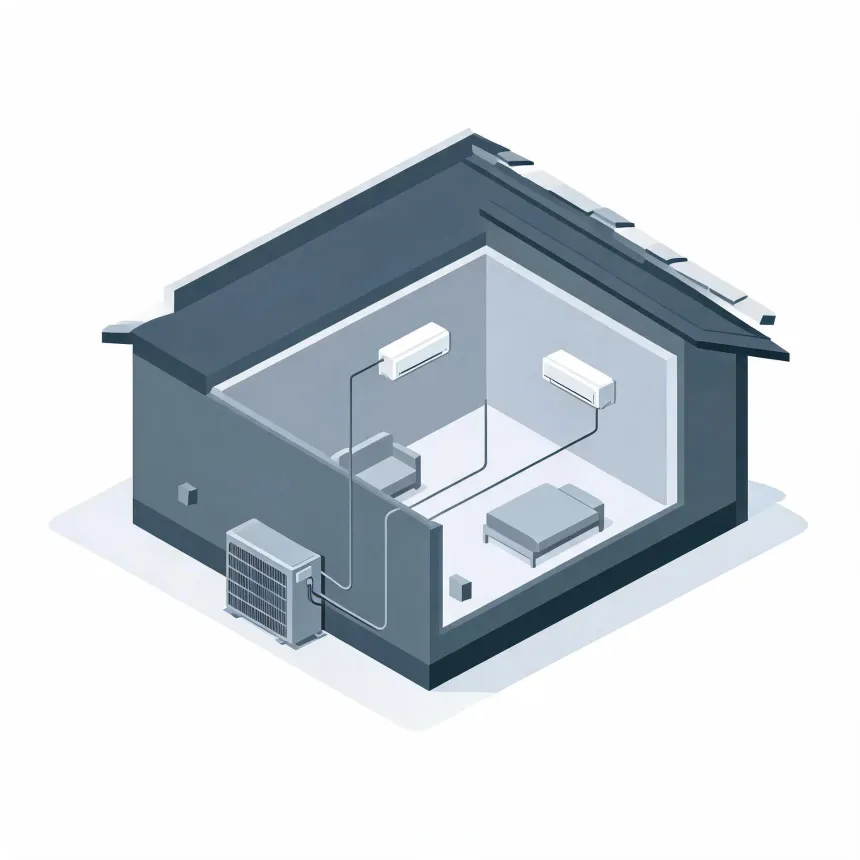
Isometric illustration of a cutaway house interior showing two wall-mounted indoor air conditioning units connected by line sets to an outdoor condenser unit beside the exterior wall.
Your system heats September through May and cools July through August.

NOAA nClimDiv, 1991–2020 normals

Waldoboro has old homes and new ones in close to equal numbers.

A mini split sized for this job comes from the room it heats and cools, not from the age of the house.

Most homes in Lincoln County heat with oil, and a mini split works alongside that

56.5% of homes heat with fuel oil
Cooling runs July through August
Summer afternoons average 75°F
Cooling duty here is shortYour mini split only has to earn its keep from July through August, with afternoons averaging 75°F.

Lincoln County is zone 6A under the 2021 energy code, a cold climate with winter running long here. Any mini split installed has to clear the federal minimum for split-system heat pumps. That means 14.3 SEER2 for cooling and 7.5 HSPF2 for heating, the same floor whether the system is ducted or ductless, since the standard doesn't treat mini splits as their own class. That rules out older or bargain units that can't hit those numbers. A system that clears the minimum may also qualify for the federal energy efficiency tax credit, worth asking an installer about while you're comparing options.

Have it in before July

Cooling here only runs from July through August, which means June is the last quiet month to get a mini split installed. Do it then and the install happens on a normal schedule instead of competing with the first hot week.

Find a contractor
A white outdoor air conditioner condenser unit mounted on metal wall brackets against gray horizontal siding, with a blue sky and white clouds behind it.

The label tells you about the compressor, not the room

The SEER2 and HSPF2 numbers on the label describe efficiency, not how well the system will heat or cool a given room. A high rating means the compressor moves heat using less electricity per unit of work, which matters most in a system that runs constantly rather than one cycling on and off a few times a day. For a mini split, what matters just as much is the inverter driving that compressor. An inverter-driven unit ramps its output up and down to match the load instead of switching fully on and off, so it holds steady output over long runs without the wear that comes from constant cycling. That's part of why a mini split's rated efficiency tends to hold up closer to its label number over the years than a single-stage system's does. None of this tells you the right size for a room. A unit rated high on efficiency but oversized for the space will still cycle hard and short, which is harder on the compressor than running a right-sized unit steadily.

The old system doesn't have to go

If oil heat or a furnace is staying in place, the mini split gets added alongside it. There's no tank to drain, no gas line to cap, no furnace to haul out. The installer runs new lines and mounts new equipment, and the old system keeps working the way it always has until you decide otherwise.

Full replacement means disposal is part of the job

If the old equipment is coming out for good, a furnace or boiler needs to be disconnected from gas or oil supply and vented properly before it's removed. An old AC condenser holds refrigerant that has to be recovered, not vented, before the unit can be scrapped. A licensed installer handles both as part of the swap, so this isn't something to plan around separately.

Ask how many zones each proposal covers and whether that matches how you use the space. A single indoor head handles one room well. If the plan is to cover more of the house, ask whether that means one outdoor unit running several heads or more than one separate system, since that changes how the zones perform and how they get serviced later on. Ask what happens if one indoor head needs a repair. On some multi-zone setups the rest keep running, on others the whole system shuts down. Ask how far the outdoor unit will sit from each indoor head, since a longer line set can affect how well a system holds its rated output. Ask too what the warranty actually covers, the compressor alone or the whole system, and whether that coverage depends on who installed it.

Installation day starts with the line set, the copper tubing that connects the outdoor unit to each indoor head. The installer runs this through a wall, usually with a small hole drilled right behind where the indoor unit will mount. That line gets charged with refrigerant, wrapped, and sealed, and the quality of that seal matters more than almost anything else in the job. A sloppy connection leaks refrigerant slowly over years, and by the time you notice weak heating or cooling, the charge is already low. The indoor head mounts on a bracket against the wall, and the outdoor unit sets on a pad or bracket outside, leveled so condensate drains the way it should instead of pooling. Once everything is connected, the installer pulls a vacuum on the line set before opening it to refrigerant, which clears out moisture and air that would otherwise damage the compressor. Only after that does the system get powered up and tested, checking temperatures at each head and making sure the outdoor unit cycles the way it's supposed to.