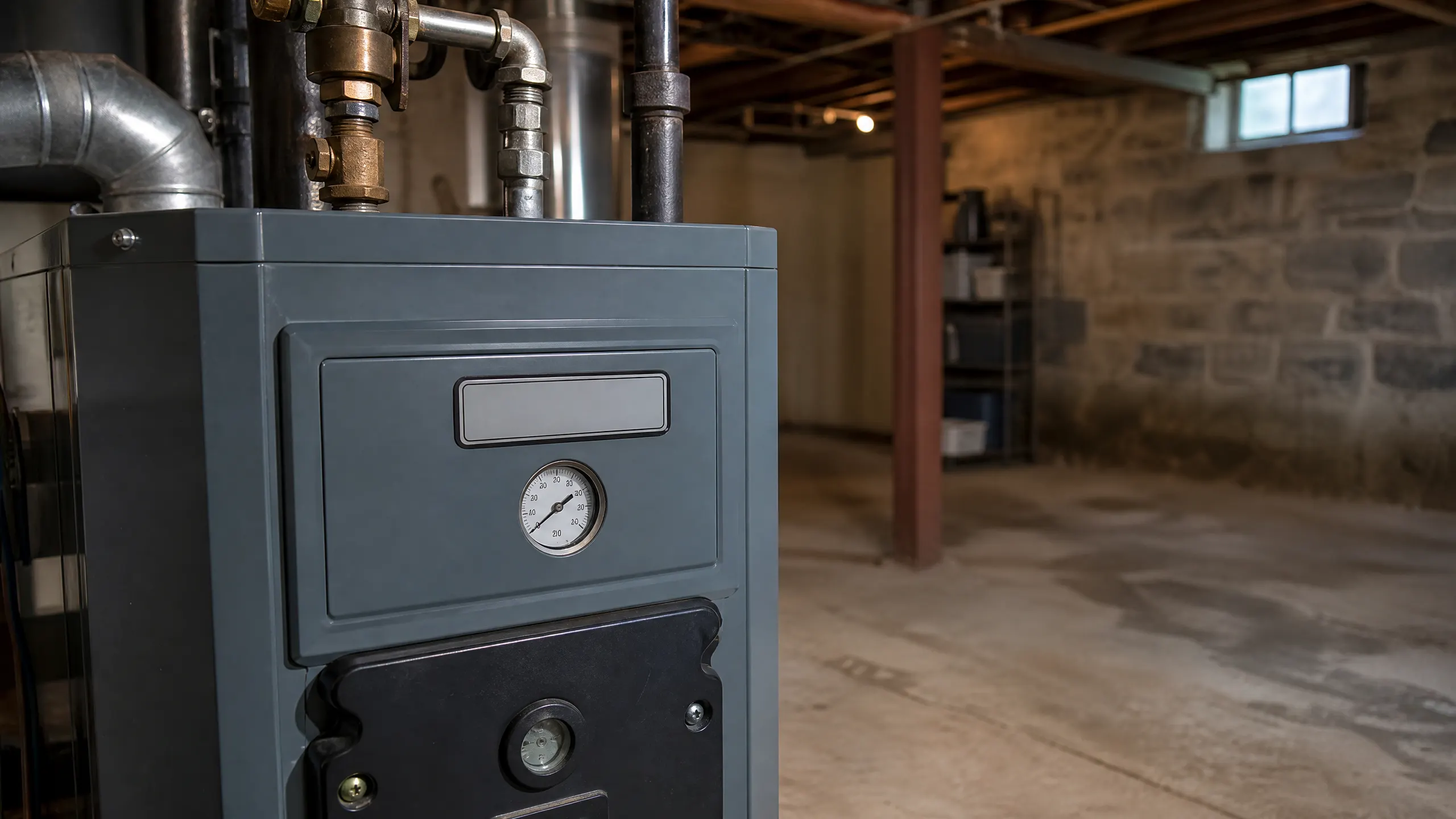
A gray residential boiler with brass pipe connections and pressure gauges installed in an unfinished stone-walled basement.

Boiler Installation in Calais, ME

Tell us about the job

Takes about a minute. No obligation.

New system or replacementBoilerWashington County, ME
Step 1 of 2

What ZIP code is the job in?

August is the month to call

Heat season in Washington County starts in September and runs through May, nine months straight. A boiler going in during August gets installed before anyone needs it running, with no pressure to get the house warm that same night.


A rushed install is a different job

Wait until the first cold snap and you're choosing a boiler the same week you need heat, with whatever crew and whatever unit can get there fastest. A boiler sized and set up before that lets the installer check the venting and the piping instead of racing the thermostat.

Heat runs nine months here, September through May, with overnight lows averaging 14 degrees in December, January and February.

A boiler for Washington County has to be sized for that winter, not picked for whatever's cheapest to install.

Oil here runs $23.73 per million Btu, and a boiler that wastes heat burns it all winter long

Heat runs September through May
Winter nights average 14°F
128 winter storms from 2015 to 2024
A standard boiler is the right callHalf the homes in Washington County were built in 1975 or earlier, half later. Neither one changes what size or efficiency a boiler needs here.

Fuel oil heats 59.2 percent of the homes in Washington County, more than gas, electric and propane combined. That's what most boilers here run on, and it's part of why replacing an oil boiler with another oil boiler is usually the straightforward path. The piping, the tank and the venting are already set up for it. Switching fuels means new infrastructure on top of the new boiler, and that's a bigger job than most people are asking for when they call. If the house already burns oil, the question is usually which oil boiler, not which fuel.

A new boiler here has to meet zone 6A

Washington County sits in climate zone 6A, which calls for a cold-climate heating standard. If the new boiler runs on gas, it has to hit at least 84 percent AFUE. That floor is already set, so the question left is which boiler clears it and fits what the house already runs on.

Find a contractor

The boiler is one part of the bill

A new boiler usually means new venting to match it, and often new piping if the old runs don't suit the unit going in. A boiler that vents through a chimney is a different install than one that vents through a wall. Zoning valves, a circulator pump, an expansion tank, a backflow preventer. Whether the house already has these or needs them changes the job more than the boiler itself does.

Matching the boiler to the house costs more up front, less after

A boiler sized to the actual heat loss of the house runs steady and lasts out its years. One sized off a guess, or matched to the old unit without checking, ends up wrong both ways. Too big and it short cycles. Too small and it runs flat out just to keep up. Either way the boiler wears out early. The sizing work costs something at install. Skipping it costs more over the life of the unit.

A boiler's size comes from a heat loss calculation, room by room, not from the size of the one being replaced. The contractor looks at the walls, the windows, the ceiling height, how much of the house faces the wind, and adds it up to a number in Btu per hour. That number is what the new boiler has to match. Go bigger because it seems safer and the boiler short cycles, firing on and off all day instead of running a long steady burn. Short cycling wears the heat exchanger and the igniter faster than normal use ever would. A boiler sized to the actual number runs longer stretches at a lower fire, holds the house at temperature, and burns fuel the way it was designed to.

The old boiler comes out first, and that part takes longer than people expect. The piping and venting have to come apart without tearing up what stays behind. The new unit gets set in place, leveled, and tied into the supply and return lines. Venting goes in next, matched to how that particular boiler exhausts, because not every boiler vents the same way. Electrical hookups follow, along with the gas or oil line, and any zoning valves or circulators the system needs. Before anything fires, the system gets purged of air and every joint gets checked for leaks. Only then does the contractor fire the boiler, watch the burn, set the water pressure, and confirm each zone is actually calling for heat and getting it. Nobody walks away until it's been watched through a full cycle, not just switched on.