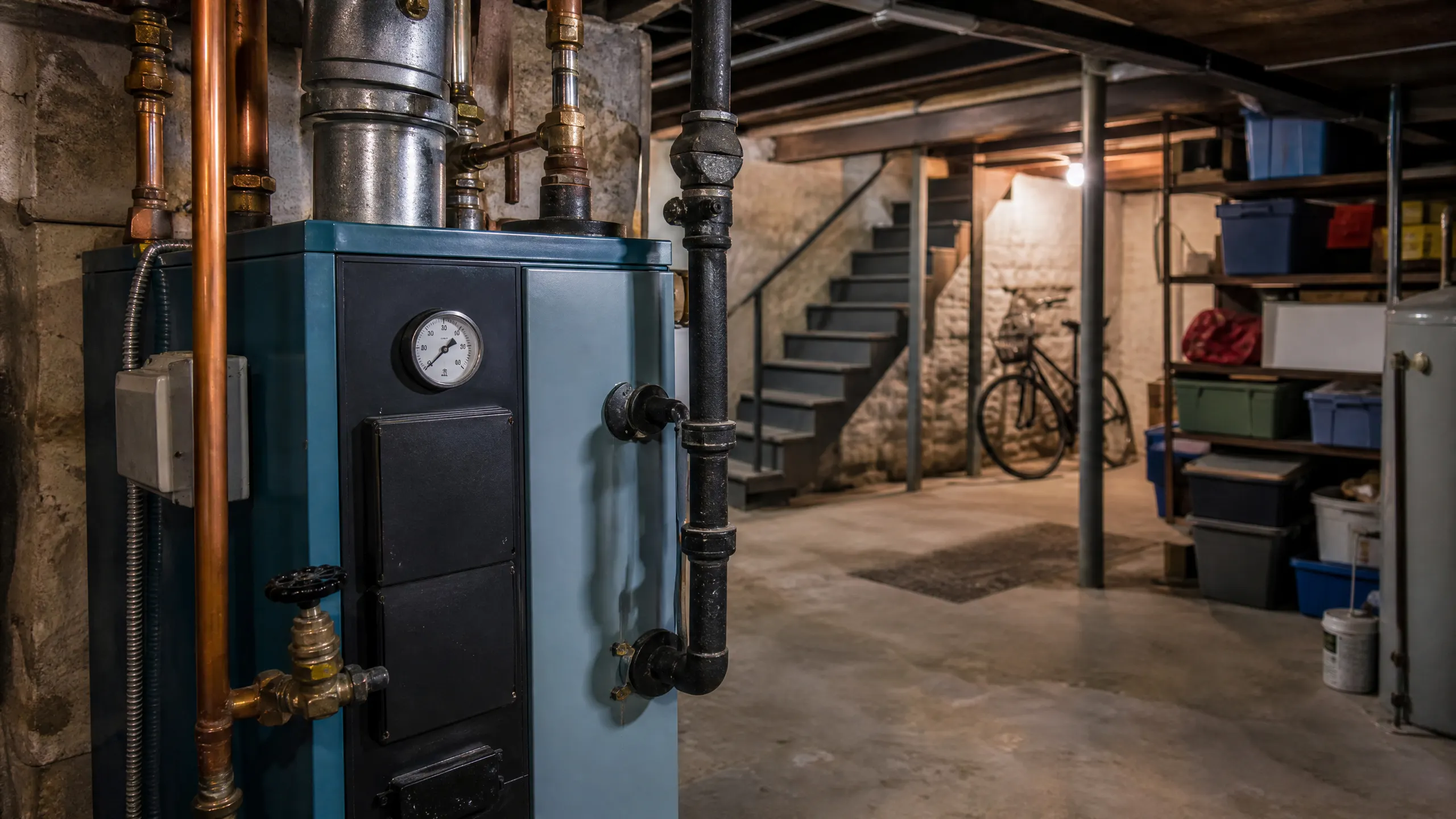
A residential basement showing a blue boiler with copper and iron pipework in the foreground, with storage shelves, a bicycle, and a staircase in the background.

Boiler Repair in Ellsworth, ME

Tell us about the job

Takes about a minute. No obligation.

RepairBoilerHancock County, ME
Step 1 of 2

What ZIP code is the job in?

Check the pressure gauge and the water

A boiler that's lost pressure will show it right on the gauge, usually reading low or sitting at zero. Low water pressure is a common reason a boiler shuts down or stops heating. Check for any obvious leaks around valves or pipe joints while you're there, and look at the overflow pipe outside for signs of dripping.


Know what your thermostat and breakers can rule out

Make sure the thermostat is set above room temperature and actually calling for heat, and check that it has fresh batteries if it takes them. Look at the breaker for the boiler too, since a tripped breaker will stop it cold with no other symptoms. If both check out and the boiler still won't fire, the problem is inside the unit and worth having looked at soon rather than waiting.

Boilers in Ellsworth run from September clear through May, nine months of the year.

Nine months of work a year means a boiler acting up needs a real diagnosis, not a guess.

Oil runs $23.73 per million Btu in Maine, and a boiler that's struggling burns more of it to do the same job.

Heat runs September through May
Winter nights average 14°F
67 winter storms from 2015 to 2024
September is when it shows upHeat goes on in September, and whatever was already weak gets found out fast.

Half the homes in Hancock County were built in 1982 or later. If yours is one of them, the boiler itself may be newer too, especially if it's the original unit. A boiler that's otherwise sound and just not firing right is usually a repair, not a replacement. Worn parts like the igniter or circulator pump get swapped out on their own without touching the rest of the system. Check when the boiler was actually installed if you can, since that tells you more than the age of the house does.

Get it diagnosed properly

Your boiler works hard here, and that's usually what's behind the problem. Have it diagnosed properly so the fix lasts.

Find a contractor

Most failures start with ignition or circulation

A boiler that won't light often has a bad igniter or a failed flame sensor, and one that lights but won't heat the house usually has a circulator pump that's stopped moving water through the system. Both parts wear out from regular use and get replaced on their own.

Mineral buildup wears on the system quietly

Scale builds up inside the heat exchanger over years, especially where water hardness is high, and it makes the boiler work harder to transfer heat. Left alone, it stresses the exchanger and can lead to cracks or leaks that are a bigger job than the buildup itself.

A boiler that's firing but struggling doesn't fail cleanly. A cracked heat exchanger gets worse under heat and pressure cycling, and a small leak can turn into a bigger one. A circulator pump that's starting to stick draws more current and runs hotter until it seizes completely. Low water pressure left unaddressed can cause the boiler to overheat sections of the heat exchanger that aren't getting water, and that kind of heat stress doesn't undo itself. The longer a boiler runs with one of these problems, the more parts around the original fault end up affected too. A repair caught early is usually smaller than the one that follows it.

A diagnostic visit starts with questions, not tools. What happens when it fails to fire, what sounds it makes, whether it's been losing pressure over time or all at once. From there it's a check of the controls first, the thermostat signal, the transformer, the aquastat, because those rule things out fast before anything gets opened up. Pressure and the expansion tank get checked together, since a tank that's lost its air charge will let pressure run high or low depending on the day. If the boiler fires, the next watch is the flame itself, whether it lights clean and holds or struggles and drops out, which points straight at the igniter or the flame sensor. Only after all that gets opened up does the heat exchanger or circulator pump come into question, and usually only one of them turns out to be the actual problem.