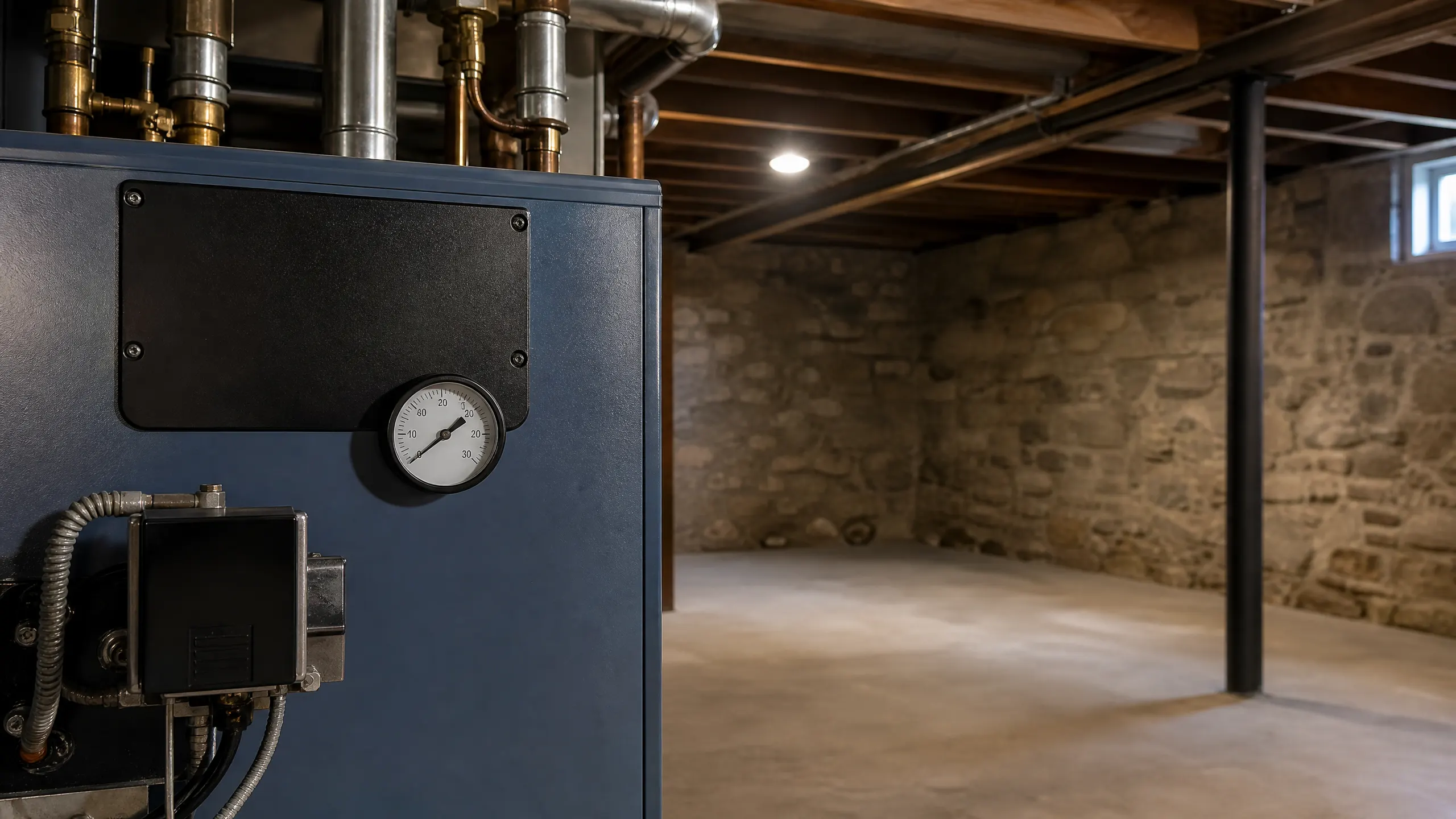




A blue boiler with copper pipework and a pressure gauge mounted in an unfinished basement with stone foundation walls.

Boiler Repair in Lewiston, ME

Tell us about the job

Takes about a minute. No obligation.

RepairBoilerAndroscoggin County, ME
Step 1 of 2

What ZIP code is the job in?

A tech starts by asking what the boiler is doing. No heat, a leak, strange noise, short cycling. Then they check the pressure on the gauge and look at the water level. Low pressure alone can cause a boiler to lock out or refuse to fire. They'll pull the cover and look at the burner and heat exchanger for soot or scale. Either one points to a combustion problem rather than a control problem. If the boiler is firing but not heating the house, they trace it through the circulator pump and the zone valves to see which one isn't moving water where it needs to go. A gas boiler gets its flue and venting checked too. A blocked vent will trip a safety switch on purpose. Most of this is done by hand, with gauges and a multimeter, before anything gets taken apart or replaced.

Boilers in Lewiston sit idle from spring until September, when the heat goes back on.

A boiler in Lewiston often fails in September, when it first has to work hard again.

Nine months of heat and nights near 13°F put real strain on a boiler here

Heat runs September through May
Winter nights average 13°F
45 winter storms from 2015 to 2024

Half the homes in Androscoggin County were built in 1969 or earlier. A boiler that age has usually been replaced at least once, but if yours is original to the house, or came with it from whoever owned it before, that's worth knowing before you spend money fixing it. A contractor can look at the unit and tell you roughly how much life is left in it. That's not something you can guess from how it's acting now. A boiler near the end can still run fine for a stretch, then fail again the next time it has to work hard. Ask straight out what they think it's got left before you decide what's worth repairing.

A boiler burning oil poorly costs you every time it fires

Fuel oil ran $23.73 per million Btu in Maine in 2024. A boiler that's short cycling or struggling to fire wastes that oil instead of turning it into heat. Get it looked at before the next cold stretch asks more of it.

Find a contractor
A man in a navy long-sleeve shirt and tan work pants, seen from behind, carries a canvas tool bag up light-colored porch steps toward a blue front door.

Cold radiators, or ones that stay cool at the bottom

A radiator that never gets hot, or feels hot on top and cold at the bottom, usually has air or sludge trapped inside it. Bleeding it fixes air in minutes. Sludge means the system needs flushing, which is a bigger job and worth having a tech confirm before you guess at it.

Banging or kettling from the boiler itself

A knocking or rumbling sound as the boiler heats up usually means scale has built up on the heat exchanger, the same way a kettle gets loud with age. It will not go away on its own, and left alone it stresses the heat exchanger until it cracks.

Check the pressure gauge first. Most boilers want the needle in a marked range, and if it has dropped below that, the system can lock out or run without heating properly. There is usually a filling loop you can open to bring it back up yourself, slowly, until the needle sits where it should. Look at the boiler itself for any sign of water underneath or around the fittings. If there is a fault code or warning light showing, write down what it says before you call. Don't take the cover off or go near the burner or the electrics yourself. That part is for someone who does this for a living.

A boiler that needs a repair a year isn't necessarily in trouble. Most parts on a boiler, a pump, a valve, an ignition component, fail one at a time and get replaced one at a time, and that's normal wear over a long service life. What changes the math is the heat exchanger. That's the part that can't really be repaired, only replaced, and a crack or heavy scale on it usually means the boiler itself is done. The other thing worth weighing is how the repairs are trending. One failure in a few years is nothing. Failures stacking up closer together, or a system that needs a reset or a restart more often than it used to, is a boiler telling you it's working harder to do the same job. At that point a tech can tell you whether you're looking at another repair or a replacement, and it's worth asking them straight rather than guessing.