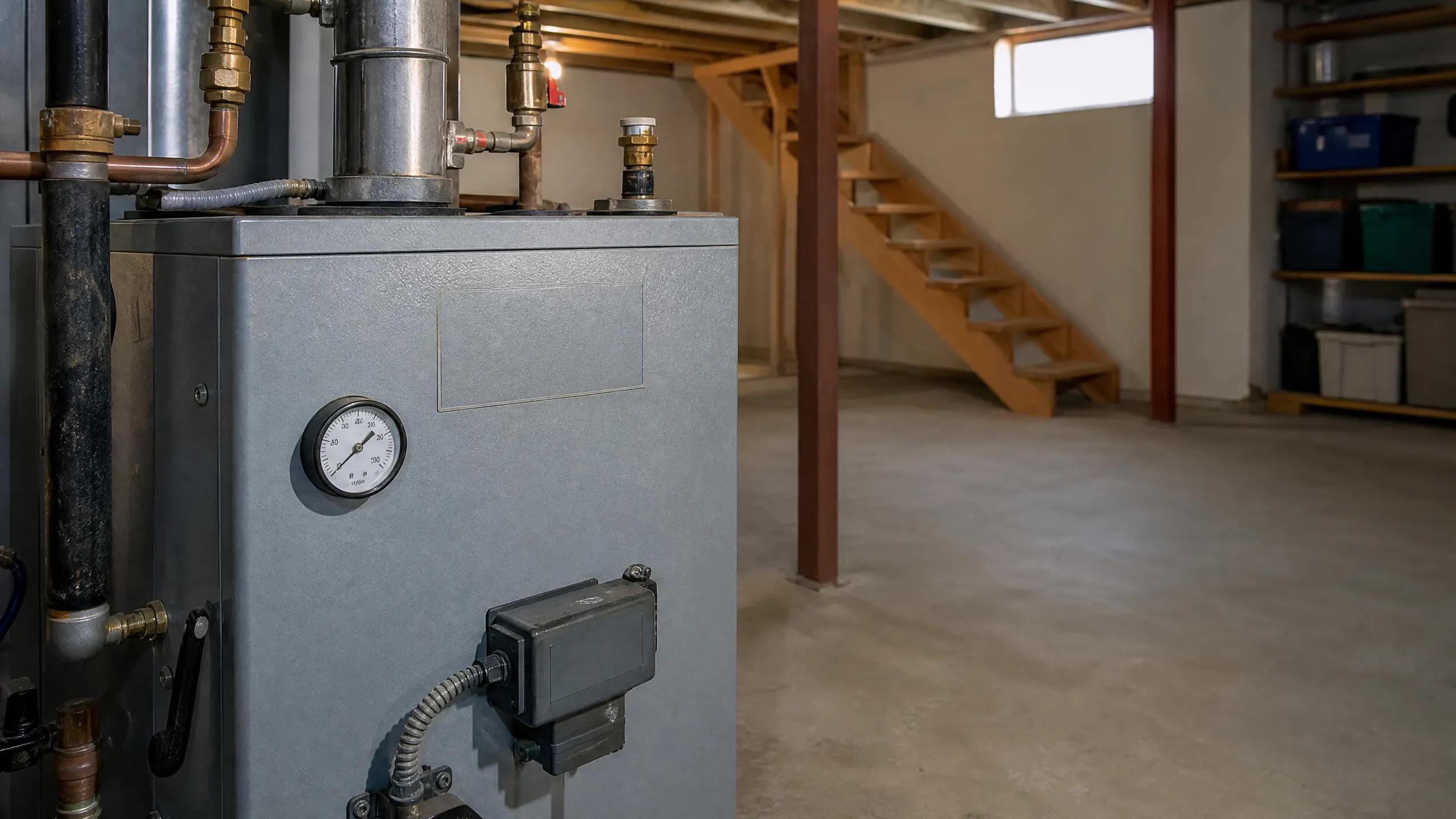



A gray boiler with copper pipes and a pressure gauge stands in an unfinished basement with wooden stairs and concrete floors.

Boiler Repair in Rumford, ME

Tell us about the job

Takes about a minute. No obligation.

RepairBoilerOxford County, ME
Step 1 of 2

What ZIP code is the job in?

A boiler that's acting up isn't always on its way out. A failed igniter, a stuck zone valve, or a bad circulator pump are repairs, not reasons to replace the unit. The heat exchanger is a different story. If that's cracked or leaking, patching it isn't a real option, and a tech will tell you it's time to start pricing a new system. Age matters too, since older boilers run less efficiently and parts get harder to find the longer a model's been out of production. If your boiler is getting on in years and the repair calls keep coming, that pattern is worth paying attention to.

Rumford homes split about evenly between built before 1977 and after.

Either way, a boiler acting up there is a house question less than a boiler one, usually a worn part or a unit that's reaching its years.

A boiler that runs every winter on oil this expensive can't afford to run badly

Heat runs September through May
Winter nights average 10°F
100 winter storms from 2015 to 2024

Boilers here start working in September and keep going through May, nine months of runtime. That first cold snap in September is when a weak part finally gets tested. A circulator pump that's been sitting quietly all summer will seize up once it's asked to run for hours instead of minutes. A zone valve that sticks a little will stick all the way. If your boiler is going to act up, those first few weeks are when you'll find out, not later once it's already proven itself. Getting it looked at in August means a tech can catch the weak part before the season does.

Nine months of winter is a long time to run on a guess

Nine months of runtime and overnight lows averaging 10°F put real strain on a boiler's parts. Add the ice and heavy snow this county sees most winters, and a system that's already struggling has no room to coast. A proper diagnosis now finds the part that's actually failing, so the repair holds through the rest of the season.

Find a contractor

What you'll actually notice first

A boiler in trouble rarely just shuts off. Usually it's banging or knocking in the pipes, a radiator or baseboard loop that stays cold while others heat fine, or a pilot or ignition light that won't stay lit. Short cycling, where the boiler fires up and shuts off again within minutes, is another one worth paying attention to. Any of these is your boiler telling you something specific, not just getting old.
What those signs mean for the job

Each symptom points a tech toward a different part before they even open the panel. Knocking pipes usually means air or sediment, a straightforward fix. A cold zone points to a stuck valve or a dead circulator pump. A pilot that won't hold suggests a thermocouple or igniter problem. Short cycling can mean a pressure issue or a failing sensor. Telling the tech exactly what you noticed, and when, gets the right part checked first instead of a slow process of elimination.

Most boiler failures trace back to a handful of parts, and they fail for ordinary reasons. A circulator pump wears out at the bearings or seizes after sitting idle, and once it can't push water through the loops, you get heat in some rooms and none in others. Igniters and thermocouples burn out from age and from firing on and off thousands of times over the years. Zone valves stick when the motor that opens and closes them wears down, or when mineral buildup keeps them from seating right. Low water pressure or a waterlogged expansion tank will cause a boiler to shut itself off as a safety measure, which looks like a bigger problem than it usually is. The heat exchanger is the one part that doesn't fit this list, since corrosion or a crack there isn't something a tech replaces on its own. Most of what sends a boiler into repair is a single worn part doing exactly what worn parts do.

A diagnostic visit starts with questions, not tools. What's cold, when did it start, did the boiler make any noise first. That narrows things down before the panel ever comes off. From there a tech checks water pressure and the expansion tank, since a low-pressure shutdown looks dramatic but isn't. Next comes the circulator pump, checked by hand for a seized bearing or a motor that hums but doesn't spin. The gas valve, igniter or thermocouple get tested in sequence if the pilot won't hold. Zone valves get checked open and closed, since a motor that's worn or a valve full of mineral buildup won't seat right either way. The heat exchanger gets inspected last, because if that's cracked, nothing else about the visit matters as much as that one answer.