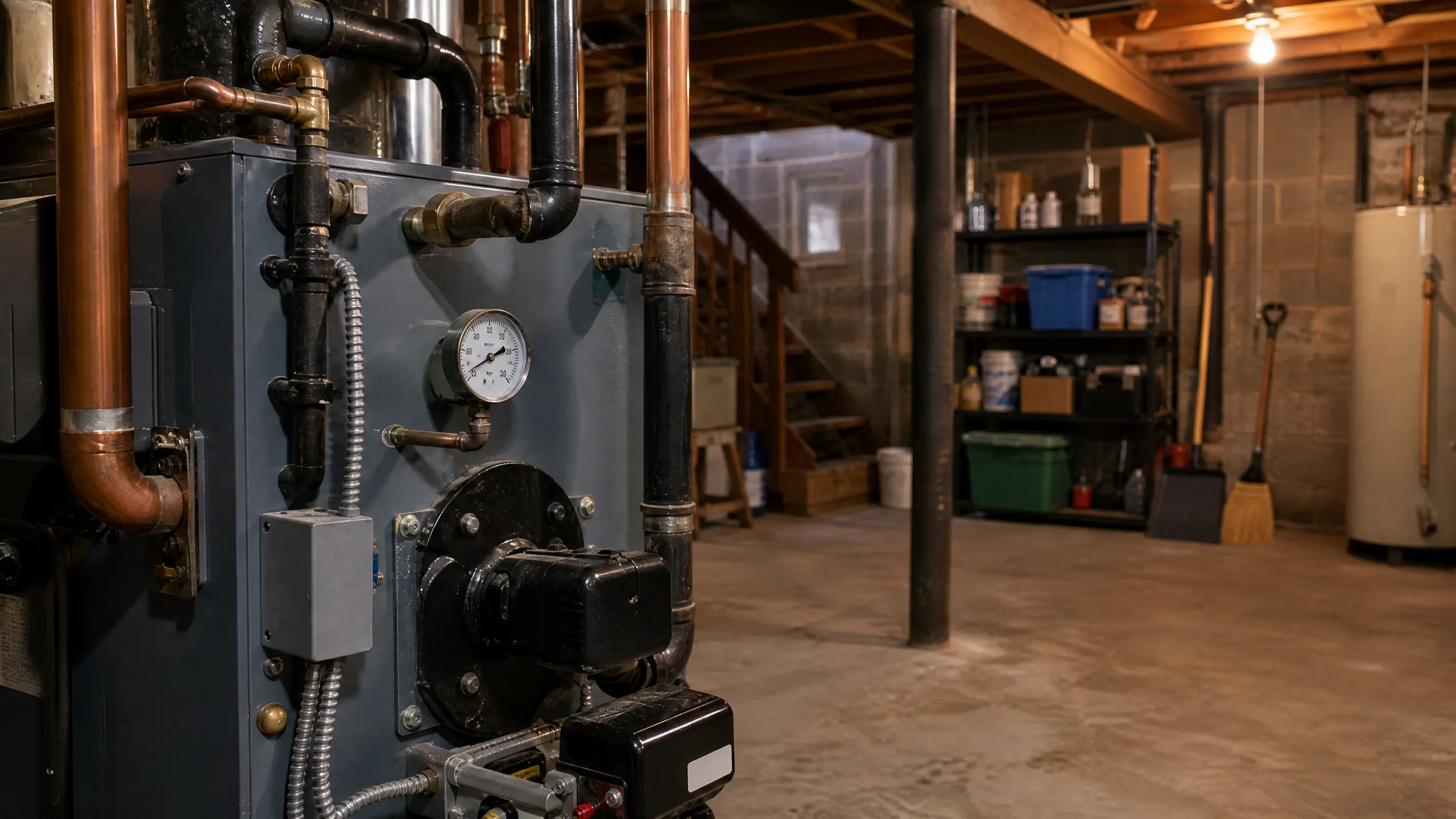
A basement mechanical room with a gray boiler connected to copper and iron pipes, a pressure gauge, and a water heater visible in the background.

Boiler Repair in Waldoboro, ME

Tell us about the job

Takes about a minute. No obligation.

RepairBoilerLincoln County, ME
Step 1 of 2

What ZIP code is the job in?

Nine months of heat a year

Boilers in Waldoboro run from September through May. Overnight lows average 16°F through December, January and February, so the burner is cycling on for most of the day and night across the coldest stretch. That kind of run time wears on a boiler faster than in places where heat is a sometimes thing.


Long hours mean problems surface early

A boiler running nine months a year shows its weak points sooner, a failing igniter, a circulator pump losing strength, a pressure issue that would take years to matter somewhere milder. When something acts up, it is worth finding the actual cause rather than guessing, since a boiler on that kind of schedule does not have much slack left to run on a bad fix.

Winter storms hit Lincoln County 43 times between 2015 and 2024.

A boiler that loses power mid-cycle needs checking before it's trusted again.

Half the homes here are old enough that the boiler problem is probably one of the usual ones

Half the homes here were built by 1978
Heat runs September through May
Winter nights average 16°F
The cost of running a boiler here is highFuel oil ran $23.73 per million Btu in Maine last year

Boilers here start the season in September, which makes August the month to get one looked at before it has to run. A boiler that sat idle all summer and gets asked to fire every day in September is where a weak igniter or a stuck valve usually shows itself. Catch it in August and it's a quiet repair. Wait until the season's already started and it's a house with no heat while someone waits on a part. The nine months of running time ahead don't leave much room for a problem that started small to stay small.

Find out what's actually wrong before the heat has to run again

A boiler running nine months a year doesn't have much slack left for guesswork. If yours is acting up, get the actual cause found and fixed, not just patched until the next cold snap.

Find a contractor
A man in a cap, gray long-sleeve shirt and tan work pants carries a canvas tool bag up gray porch steps toward a dark blue front door, with a blue ceramic planter and shrub beside it.

What a boiler tells you before it quits

A boiler rarely fails without warning. Banging or knocking from the pipes means air in the system or a kettling heat exchanger. Short cycling, where the burner fires and shuts off again and again, points to a thermostat problem, a clogged filter, or low water pressure. A pilot or igniter that won't hold, a thermostat that can't keep the house at temperature, or a pressure gauge sitting outside its normal range are all the machine telling you something's wrong before it leaves you without heat.

A small problem left alone becomes a bigger one

A boiler making noise or cycling short is usually still running, which is exactly why it gets ignored. A circulator pump straining against air in the lines wears out faster than one that's bled and serviced. A heat exchanger that's kettling is scaling up toward a crack, not easing off on its own. What a tech could have cleared in one visit turns into a part that has to be replaced instead of repaired.

Before anyone comes out, a few things are safe to check. Look at the pressure gauge on the front of the boiler. If the needle has dropped down near zero, that alone can stop it from firing, and the fix might be as simple as the feed valve. Check that the thermostat has power and is actually calling for heat, since a dead battery or a setting bumped down looks like a boiler problem and isn't one. If there's a reset button, it's fine to press it once. If the boiler fires and keeps running, good. If it trips again, stop there and leave it alone, since pressing it over and over can mask a flame or ignition fault that needs a tech to find. Leave the boiler itself closed up, and stay away from the gas valve and the wiring.

A boiler that's acting up isn't automatically a boiler that needs replacing. Most repairs, a new igniter, a circulator pump, a pressure switch, are worth doing on a boiler that's otherwise sound, since the heat exchanger and the burner are the expensive parts and they usually outlast the smaller components around them. What changes the math is a crack in the heat exchanger or a history of repeated repairs on the same unit. One points to replacement because that part isn't fixed, it's replaced, and the cost of doing that often sits close to a new boiler anyway. The other means something about the system is still wrong even after the last fix, and the next repair is likely to be a different part failing for the same underlying reason. A tech who's seen the unit can tell you which situation you're in. Age on its own doesn't decide it, a well-maintained boiler can run a long time, but a tired one that's needed a repair every season is telling you something the gauge and the pilot light can't.